Contents
Key takeaways:
- A board resolution is a document recording the result of a vote conducted by the board of directors on a particular issue.
- A resolution to open a bank account specifies who can open and manage the company’s accounts, protecting both the bank and the company from unauthorized transactions.
- Following a Hong Kong board resolution template can help you draft a professional and compliant resolution, increasing chances of bank account opening.
What is the board resolution in Hong Kong?
A board resolution is a written document recording the result of a vote conducted by the board of directors to approve a course of action. It is proof of the board’s assent, making it a legal safeguard that offers protection to key personnel who act on behalf of the company. You may think of it as a legally enforceable permission slip to carry out the board’s decisions.
In Hong Kong, a board resolution is necessary for most decisions concerning the daily management of the company, such as opening a corporate bank account. In the context of bank account opening, the board resolution authorises key personnel to open the account and establishes who can sign documents on behalf of the company. In this way, the board resolution further protects the company and the bank from unauthorized transactions and fraud.

Resolution to open a bank account: How is it passed?
A board resolution does not come out of thin air; it is the result of a structured process.
The specific procedures of how a company passes resolutions are written in black and white in its Articles of Association (AoA)—a legally binding “rulebook” agreed upon by directors and shareholders at the moment of incorporation. Most companies adopt Model Articles—the default AoA provided by the Hong Kong government.
The Hong Kong government allows alterations to the AoA, provided that they comply with the Companies Ordinance. This is why procedures for passing resolutions can differ from company to company.
Among companies that adopt Model Articles, however, a resolution is passed in the following manner:
- A director calls—or authorises the company secretary to call—a directors’ meeting.
- A notice, which need not be in writing, is given to each director. It must include the proposed date, time, and location of the meeting (Source is Article 8 in AoA)
- Directors appoint a director as chairperson of the board meeting
- Chairperson formally moves the motion, then opens the floor for discussion
- A vote is conducted by a show of hands. A simple majority is required to pass the resolution
- If there is a tie, the chairman breaks the tie with a casting vote
- The board resolution is drafted, and all directors sign on the board resolution
- The directors ensure that written records of the decision are kept for at least 10 years from the date of the decision. (source for this is Article 17 of AoA)
Are physical meetings necessary to pass board resolutions?
Hong Kong Company Law is known for its flexibility.
The Model Articles state outright that it is “irrelevant where a director is and how they communicate with each other” when determining if they are participating in a director’s meeting (Article 9(2)). Article 9(3) further states that if the directors are not in the same place during the meeting, then “they may regard the meeting as taking place wherever any one of them is.” Virtual meetings, then, are completely permissible under HK laws.
If you are the sole director of your company, there is also no need to “hold a meeting with yourself.” Simply prepare a written resolution detailing the decision to be taken, sign it, and the decision will be final. (Source is Article 18 of AoA )
As we can see here, Hong Kong company law in its current form is designed to help directors navigate decision-making in a practical, streamlined, and modern way.
How to write a board resolution to open a bank account?
The board resolution is not simply a document that banks routinely collect from you—it further sets out the terms of your relationship with your future bank.
Here are some pointers for you as you draft your board resolution:
- Compliance: Ensure that the resolution is in accordance with your company’s Articles of Association and Hong Kong company law. We’d strongly recommend that you with legal professionals or your company secretary to avoid errors or non-compliance.
- Tone and Clarity: Maintain a professional tone with unambiguous wording.
- Concision: Clearly state the exact decision concisely at the beginning of the board resolution.
- Consistency in Format: Pay attention to use of fonts, spacing, and headings to communicate professionalism.
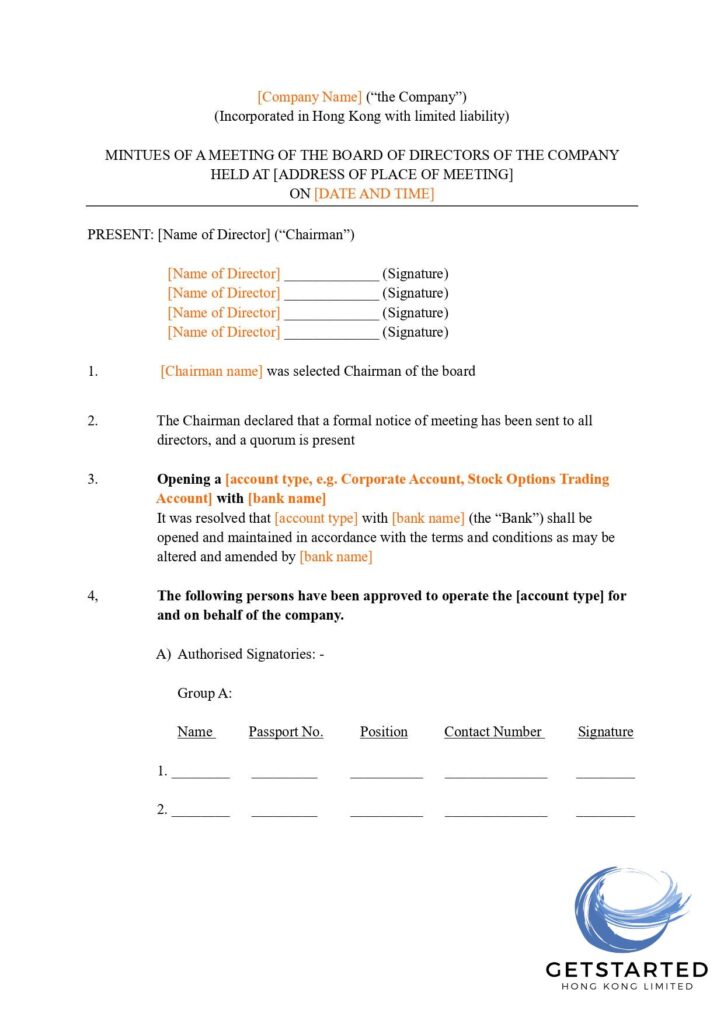
The key parts included in a board resolution for bank account opening:
- The company’s name
- The address of the board meeting location
- All directors present at the meeting
- The date of the resolution
- Phrases indicating the resolution of the decision (“It was resolved that…”)
- Name of the bank to which the company will submit an application
- Identification and contact details of the individuals authorised to manage the company’s accounts.
- Special conditions. E.g. whether certain transaction amounts require joint signatories
- Signatures from board chairman and authorised signatories
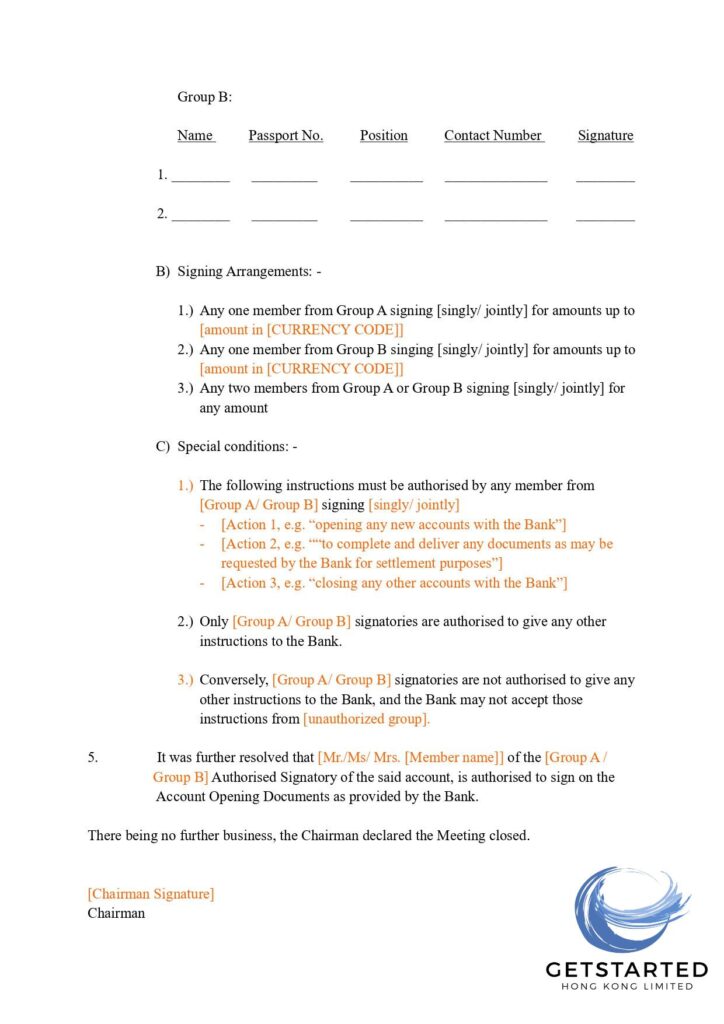
Banking resolution template, brought to you by Get Started HK
Corporate account opening can quickly transform into a lengthy process even if there is just one misstep along the way. Get everything right on the first try by downloading Get Started HK’s free Hong Kong board resolution template at the button below.
Frequently Asked Questions about collection of personal data
1. What is a LLC bank account?
“LLC” is an acronym for Limited Liability Company. This is a company limited by shares, and the Hong Kong equivalent for an LLC is the private limited company. In a private limited company, the owner and the business are considered separate legal entities, which protects the owner’s personal assets from the business’s liabilities.
Opening an LLC bank account—or a corporate account—specifically handles the business’s financial activities, such as receiving payments from customers and paying suppliers. Owners of limited liability companies should refrain from conducting personal transactions through a corporate account, as this can lead to issues with tax compliance and organization, and jeopardise the legal separation between owners and their businesses.
2. How to open a corporate bank account in Hong Kong.
To open a corporate bank account in Hong Kong, the general requirements are that you provide information about yourself by submitting KYC documents (e.g. A copy of your passport/ HKID card, a residential address proof), and provide information about your company by submitting your company documents (e.g. certified true copies of Certificate of Incorporation, Business Registration Certificate, NNC1 incorporation form, and Articles of Association ). A bank would also inquire about the management structure and shareholding structure of your company by asking for an org chart and a company ownership chart respectively.
As a compliance requirement, your bank would also ask for a board resolution authorising the one or several individuals within the company to open and manage the bank account for and on behalf of the company. This document can only be prepared after the board of directors passes the resolution to open the bank account by means of a physical meeting or a written resolution.
3. How to write a board resolution to open a bank account?
Include the necessary details, such as your company name, the directors present in the meeting when the resolution was passed,
It is imperative that the board resolution is in full alignment with the company’s Articles of Association and the Companies Ordinance to ensure successful account opening.
4. Do you need operating agreement to open bank account?
Banks in Hong Kong rarely explicitly ask for an “operating agreement,” though this document is a common requirement amongst US banks. All the same, Hong Kong banks would ask for documents that provide the same details as an operating agreement. For example, an operating agreement lays down members’ rights and responsibilities and rules governing how the company is managed. To obtain these details, banks would ask for your company’s Articles of Association and Ownership hierarchy, which details each member’s shareholding percentages and voting rights.