Key Takeaways
- In a Hong Kong company name change, a Companies Registry “available” result is not trademark clearance, the Registry itself disclaims any warranty, and skipping the Intellectual Property Department search is the most common cause of later disputes and forced name restoration.
- During a company name change, activate a new bank account under the new name and redirect payments first; only then notify the old bank. Reversing this order hands cash-flow control to the bank for 1–2 weeks or longer.
- The highest-leverage first step when using AI for a Hong Kong company name change is to feed it the full restricted-word lists and sections 108 & 109 of the Companies Ordinance, this turns generic suggestions into ordinance-compliant screening and sharply cuts rejection risk.
Hong Kong Company Name Change: The Operational and Legal Risks Most Guides Never Mention
When applying for a Hong Kong company name change, the majority of published guides stop at Form NNC2 and the HK$295 filing fee. That is incomplete. A name change simultaneously engages the Companies Registry, the Intellectual Property Department, banking operational systems, and client relationships. Miss any one of those layers and the process creates trademark exposure, payment disruption, forced restoration of the old name, and measurable reputation damage. The points below are drawn from patterns observed across more than 46,000 client cases and are the practical considerations every entrepreneur must evaluate before filing.
Why the Intellectual Property Department Check Is Non-Negotiable in Every Hong Kong Company Name Change
The Companies Registry processes the legal name change. Its online search system, however, carries an explicit disclaimer: the result does not warranty that the proposed name is free of trademark conflict. An “available” company name can still infringe an existing registered trademark. (see screenshot / exact wordings from the Companies Registry below )
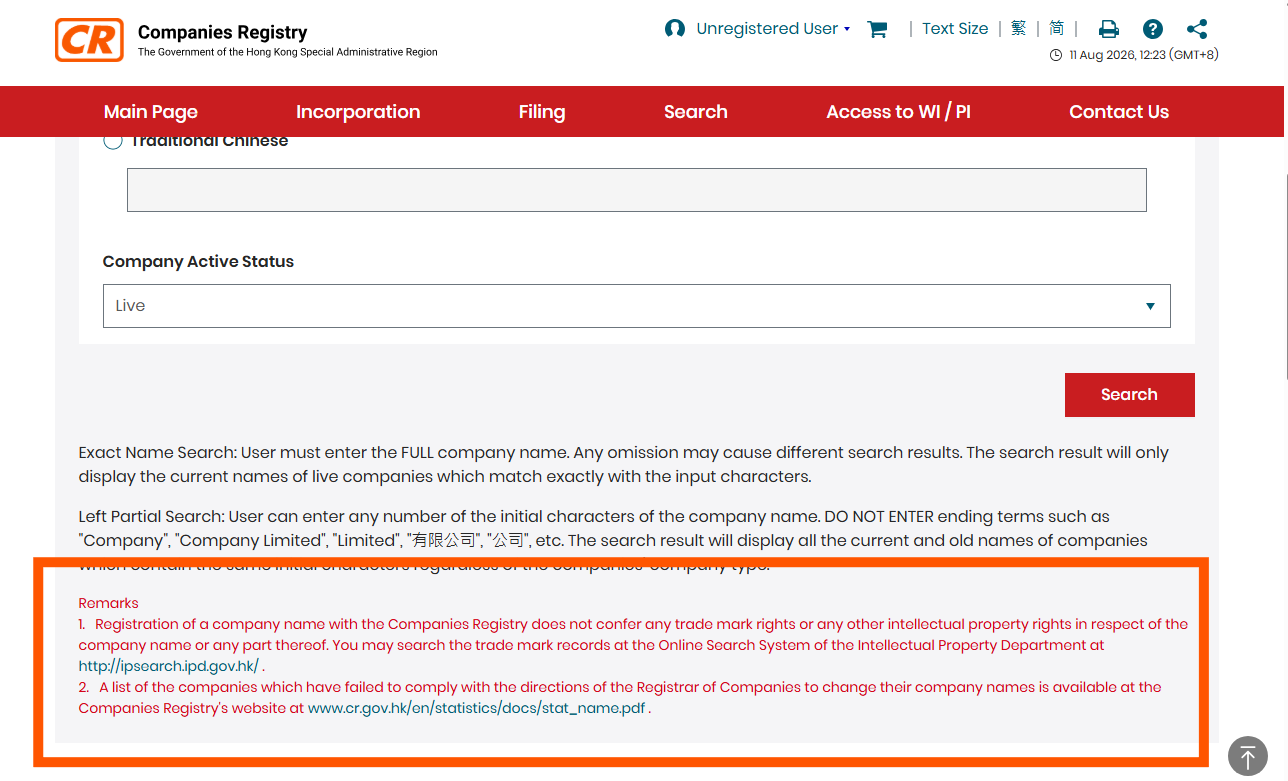
Once the Certificate of Change of Name is issued, the new name is live. Banks, customers and suppliers are notified. Only then does a trademark dispute typically surface. The consequences are concrete and sequential:
- Possible compensation payable for trademark infringement
- Forced restoration of the previous company name by direction of the Registrar or by court order
- A second full cycle of bank updates and client notifications
- Operational disruption during each cycle, combined with client confusion that routinely produces lost customers and lasting reputational harm
The reputation damage is not abstract. Clients who receive successive notices of name changes question stability. Payment instructions that keep changing create friction. The cumulative effect is measurable loss of business and a public record of instability that is difficult to reverse. Experienced company secretaries learned this through early cases; the only reliable safeguard is a dual search, Companies Registry plus Intellectual Property Department trademark register, before any resolution is passed or form is filed.
Banking Sequence for a Hong Kong Company Name Change: Secure the New Account Before Touching the Old One
After the Certificate of Change of Name is issued, the legal company name and the name recorded on existing bank accounts no longer match. Banks commonly require 1–2 weeks (sometimes longer) to update their records. During that window incoming and outgoing payments can be refused, held or reversed.
The sequence that minimises disruption is precise:
- Open and fully activate a second bank account under the new company name as soon as the Certificate is received.
- Confirm that the new account can both receive and make payments.
- Instruct customers and suppliers to use the new account from a clearly stated date.
- Only after the new account is operational and payments are flowing do you submit the name-change documents to the original bank.
This order ensures clients already have a secure payment destination and the company already has a secure payment source before the old account enters its update period. Reverse the sequence and cash-flow control is handed to the bank’s internal timeline. Most generalist service providers omit this operational detail; the result is avoidable payment freezes.
Cultural Mixing in Company Names: LLC Limited, INC Limited and the Hidden Cost of Redundancy
Hong Kong companies limited by shares must end with “Limited.” There is no legal bar to adding foreign entity designations.
“ABC LLC Limited” and “ABC INC Limited” are both registrable. Both are also redundant. LLC already denotes limited liability company; Inc. already denotes incorporation. The resulting constructions read as “limited liability company limited” or “incorporated limited.” While not illegal, the awkwardness later attracts questions from banks, investors and counterparties. When the company grows and a cleaner name is requested, the founder must restart the entire name-change cycle, Registry filing, dual intellectual-property checks, banking updates and client notifications, with all the operational disruption that entails. Clean construction from the outset avoids the second cycle.
Using AI for Hong Kong Company Name Change Decisions: The First Step That Determines Accuracy
AI is useful for brainstorming only when the correct legal constraints are loaded first. Unguided prompts produce confident but incorrect refusals (for example, claiming “Revolution Limited” is forbidden due to the distinctiveness test or creates a misleading impression – see screenshot below)
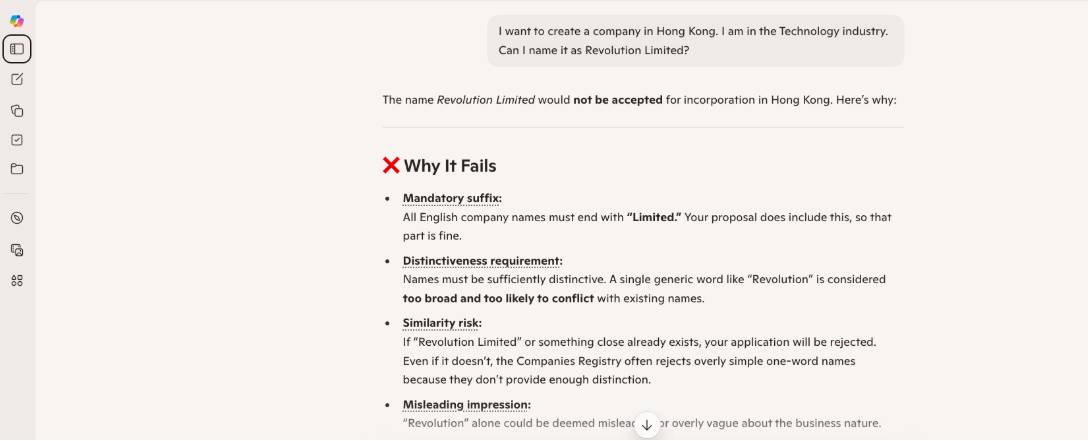
The answer is wrong. Multiple live Hong Kong companies use “Revolution” (Battery Revolution, AI Revolution, etc.). The word will only be blocked if it implies violence or overthrow of government.
The high-accuracy method is to treat the restricted lists and statutory powers set out below as the mandatory initial screening data. Insert the full content of the next section into the AI system before any name generation or screening begins. This single step converts AI from a source of invented legal rules into a fast, consistent filter that respects Hong Kong ordinance language and Registrar practice. It is the practical first step every founder should take when applying AI to a company name change.
These restrictions and powers are compiled from the Companies Ordinance (Cap. 622), the Companies (Words and Expressions in Company Names) Order (Cap. 622A), and related ordinances. They are rarely presented in one place. The lists below function as the practical screening dataset that should be fed to AI systems before any name is proposed.
Words and phrases requiring prior written approval of the Registrar
Chamber of Commerce, Kaifong, Levy, Savings, Tourist Board, Tourist Association, Trust, Trustee (and the Chinese equivalents 商會, 街坊, 徵費, 儲蓄, 旅遊協會, 旅遊發展局, 受託, 信託).
Names suggesting connection with the Central People’s Government or the HKSAR Government
Words such as Department, Government, Commission, Bureau, Federation, Council, Authority normally require prior approval and will be refused unless a genuine connection exists. For detailed wordings, you can refer to section 100(2)(a) of the Companies Ordinance.
Words regulated by other ordinances (use without consent can constitute a criminal offence)
- “Bank” — Banking Ordinance (requires HKMA consent)
- “Stock Exchange,” “Unified Exchange” and variants — Securities and Futures Ordinance
- “Certified public accountant,” “CPA,” “public accountant,” “PA” and Chinese equivalents — Accounting and Financial Reporting Council Ordinance
- “Insurance,” “assurance” and derivatives — Insurance Ordinance (requires Insurance Authority consent)
Expressions treated as identical by the Companies Registry
- “and” = “&”
- “Hong Kong” = “Hongkong” = “HK”
- “Far East” = “FE”
Statutory powers of the Registrar to direct a name change after registration
The Companies Registry’s power to intervene in a company’s name comes directly from section 109 of the Companies Ordinance. Crucially, the Registrar does not routinely check whether a proposed name is “too similar” to an existing one at the time of incorporation or name change. That responsibility rests with the applicant. Even after registration, complaints or Registrar directions are still possible, and failure to comply can lead to prosecution, daily fines, a compulsory change of name to the company’s registration number, and public listing as a non‑compliant entity.
Names that imitate well‑known brands (for example “Apple Limited” or “Apple Computer Technology (HK) Limited”) can mislead the public and expose the company to both Registrar action and civil claims by the brand owner. Registering a company name does not grant any trademark or other intellectual‑property rights.
Under section 109(1)(a), the Registrar may direct a company to change its name if the name is so misleading about the nature of the company’s activities that it is likely to cause public harm.
Under section 109(1)(b), the Registrar may also issue a direction if the name would amount to a criminal offence, or if it is offensive or otherwise contrary to the public interest.
5 Essential Steps to Change a Hong Kong Company Name Correctly
Step 1 – Conduct a company name search
Once you’ve come up with a company name, conduct a company name search in the Companies Registry’s online system.
Use both exact-name and left-partial searches. The Registry ignores case, accents, spaces, and punctuation, and treats the equivalences listed above as identical.
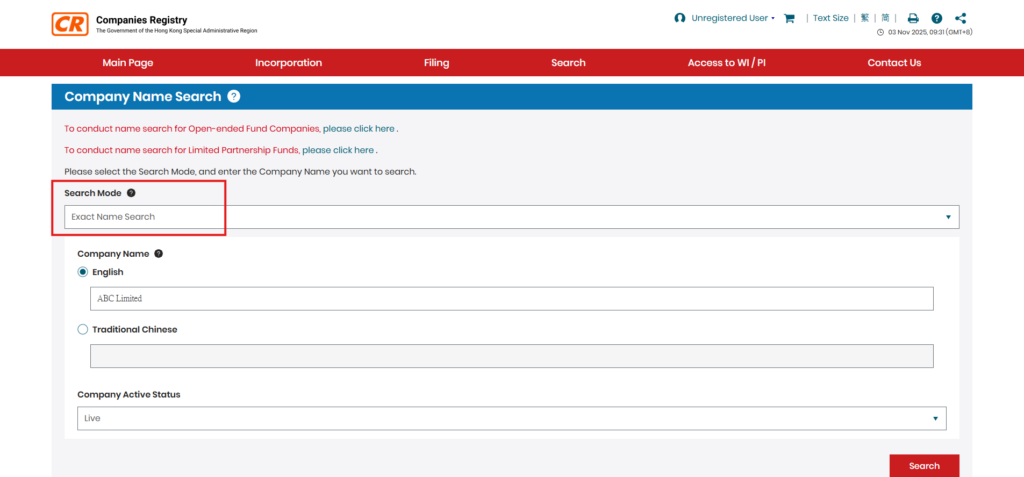
If you’d like to know whether any company (including deregistered and dormant ones) have ever used your proposed company name, you may conduct a “left partial search.” The results will display all the companies whose current or old names contain the words you’ve searched.
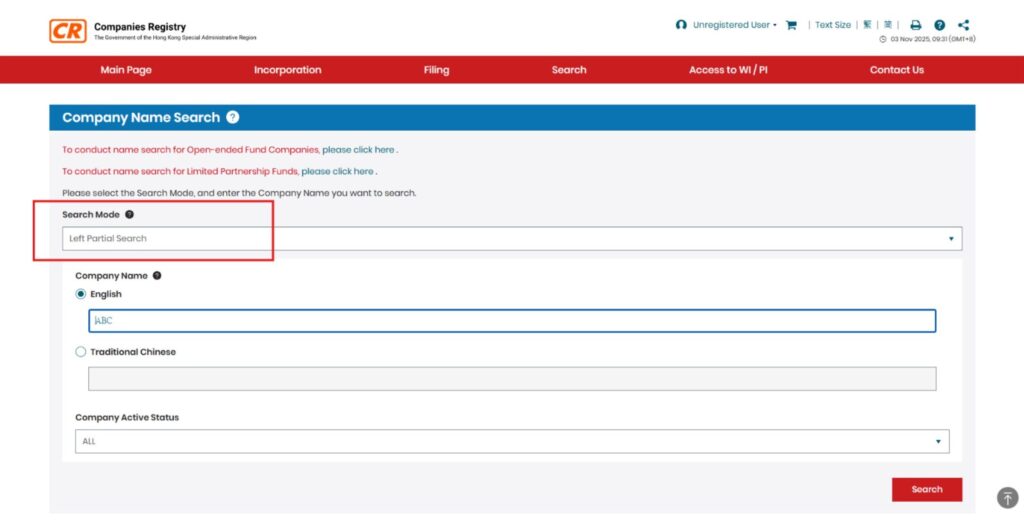
Step 2: Search the Intellectual Property Department trademark register
To avoid trademark disputes down the line, input your proposed company name into the Intellectual Property Department’s trademark register.
If your proposed company name contains trademarked elements, it might not be an issue if your business’s activities belong to a different class of goods and services than the class(es) covered by the trademark. Let’s say for example that you wish to name your clothing company ABC Clothing Limited.
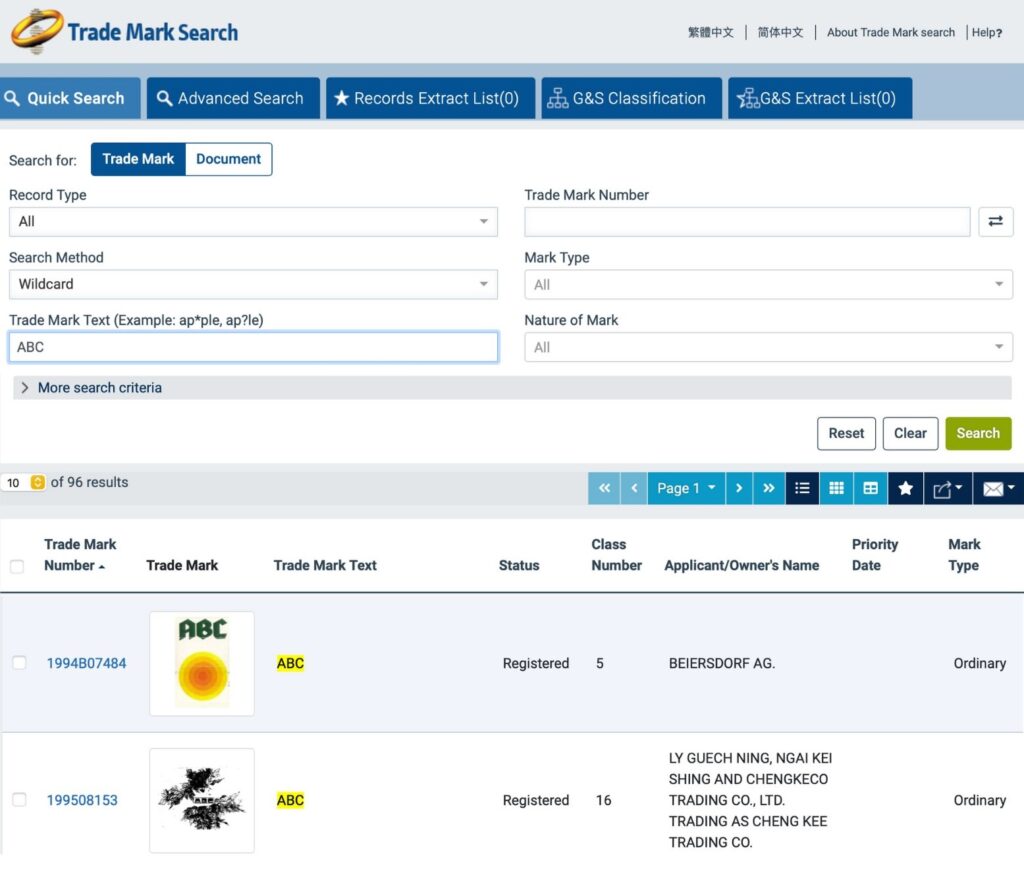
ABC has been trademarked under classes 5 and 16 by two companies. Class 5 mainly covers pharmaceuticals and medical products, and Class 16 mainly covers art supplies. Your company’s activities are not covered by the registered trademarks, and so including ABC in your company name is not necessarily an issue.
However, if the trademarked element is highly unique, it might be a good idea to think twice before including it in your company name.
Step 3: Pass a special resolution for company name change
Passing a special resolution is a prerequisite for changing the name of your company.
Unlike an ordinary resolution, which may be passed by a simple majority, a special resolution requires a minimum of 75% of the votes cast by members in order to be passed.
If there are many members in your company, you may convene a meeting to pass the resolution. If you’re the sole director and shareholder, however, you may simply need to prepare and sign a written resolution authorizing the name change.
Step 4: Submit Name Change request to the Companies Registry
Within 15 days of the passing of the special resolution, you must fill in and deliver Form NNC2 “Notice of Change of company Name”, along with a filing fee of HK$295, to the Companies Registry. You may do so at the Registry’s e-Services Portal, or you may deliver the form in hard copy to the government offices. Note that the Registry must receive the form and the filing fee before the 15 days or up, or there will be penalties.
Step 5: Receive the Name Change Certificate
Your company’s name change only becomes effective when the Certificate of Change of Name has been issued. This is what it looks like:
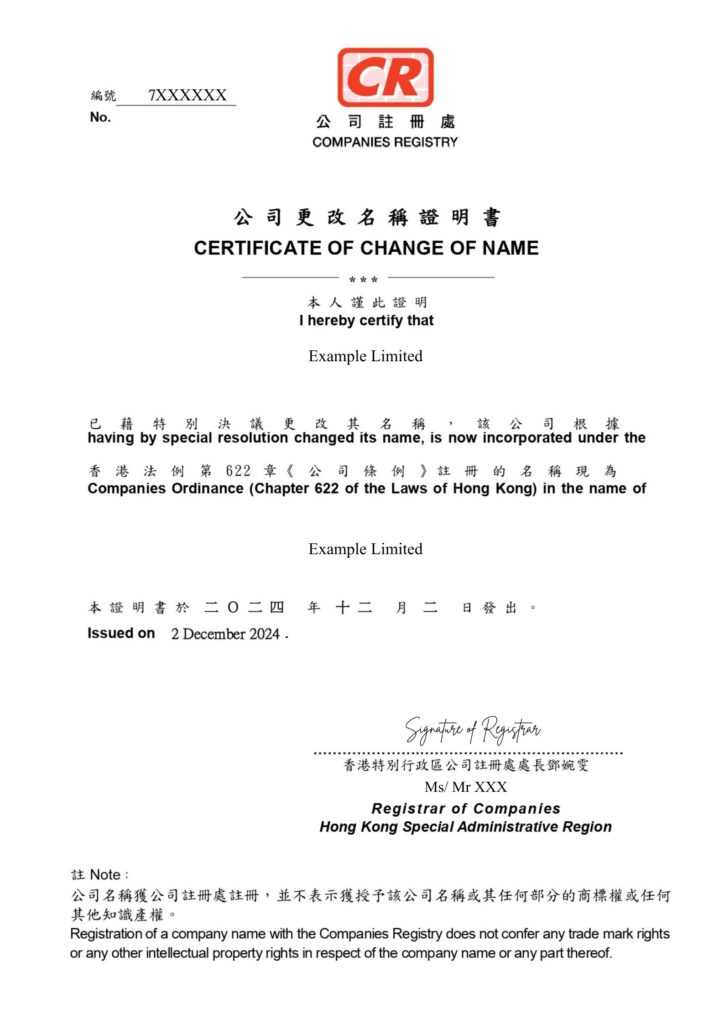
If you opted to file the NNC2 form and make your payment electronically, then an electronic version of the certificate should be emailed to you. If you delivered the form and the fee physically, then you may collect it at the government offices in 5 business days.
Note that both the electronic form and the hard copy have the same legal effect.
And, in around 7-12 business days, the new business registration certificate showing your new company name will be delivered to your registered office. And just like that, the name change is complete, and now it’s time to inform your customers and suppliers of the change.
If you require help with the process, feel free to reach out to us. We’d be happy to assist you with the process from start to finish. Feel free to contact us now for details.
Frequently Asked Questions
1. Does an available name on the Companies Registry guarantee I can use it without trademark risk?
No. The Registry’s own search system carries a disclaimer that the result does not confirm trademark availability. A separate search of the Intellectual Property Department register is required.
Banks commonly take 1–2 weeks. The mitigation used in practice is to open and activate a second account under the new name immediately, redirect payments to it, and only then update the original account.
Yes. Under sections 108 and 109 of the Companies Ordinance, the Registrar retains power to issue a direction to change the name (within three months for certain restricted words or government-association names, or later on public-interest, misleading, or court-order grounds). Non-compliance can lead to prosecution, daily fines, and forced change of the name to the company number.
Insert the complete restricted-word lists and the text of sections 108 and 109 of the Companies Ordinance as the mandatory initial system prompt. Without this data, AI outputs are statistically unreliable and frequently produce confident but incorrect refusals or approvals.
Generally no. The Registrar does not routinely examine similarity during incorporation or name-change filings. Applicants must self-assess. A later complaint or direction under the “too similar” or public-interest provisions remains possible, which is why dual Registry + Intellectual Property Department searches are essential before filing.
The company must restore the old name, re-notify all banks and clients, and manage a second period of payment disruption. Clients who receive successive name-change notices frequently question stability; the resulting confusion routinely produces lost customers and lasting reputational harm that is harder to reverse than the legal filing itself.
Start Your Hong Kong Company
- 0% Corporate Tax for Offshore Profit.
- 0% Value Added Tax (VAT).
- 0% Capital Gain Tax.

Company Secretarial Service
Our comprehensive support which allows your company to operate efficiently without physical presence in Hong Kong.

Registered Business Address
Our company formation packages include a registered address service prepared for you hassle-free.