Contents
Core insights of Company Formation Bahamas
- There are two kinds of Bahamas Company: the Domestic company and the International Business Company (IBC), and the latter is exempt from paying corporate tax in the Bahamas
- Bahamas company formation is a simple process, but one of the key requirements for foreigners is to do so through a registered agent in the region.
- Before proceeding with Bahamas company incorporation, entrepreneurs should also consider the region’s reputation and its economic substance requirements for regulated business activities (e.g. banking, insurance, shipping).
The Bahamas is not only a favourite destination for tourists, but also for entrepreneurs looking to minimise cuts on their earnings.
For almost a century now, the absence of taxes on income, wealth, and inheritance have pulled capital and foreign investors towards the Bahamas. However, the reasons go far beyond the sizable tax advantages it offers. In this article, we reveal why this Caribbean island remains a booming offshore business hub.
Why should you start a Bahamas company?
Companies in the Bahamas can broadly be divided into two categories: Domestic Companies, which are structured for local business operations, and International Business Companies (IBCs) which are structured for offshore business activities.
Tax benefits for IBCs
Unlike domestic companies, IBCs are exempt from the following taxes:
- Corporate tax
- Income tax
- Capital gains tax
- Inheritance tax
- Sales tax
Note: IBCs must still pay incorporation fees (BSD400), tariffs for imports, and an annual government fee of BSD350 (due on 1 January each year), but these are small expenses when weighed against the considerable tax benefits that IBCs enjoy.
Straightforward Company Law
The following is just Bahamian government imposes very few restrictions on IBCs:
- Directorship: IBCs can have as few as one director, and they can be either an individual or a corporation. Unlike Singapore and UAE, there is also no restriction on the director’s residency.
- Nominees: Both shareholders and directors can be nominees
- Annual General Meetings (AGMs): No AGMs are required for IBCs
- Company Secretary: A company secretary is only optional for IBCs
- No restrictions on share capital amount: The Bahamian government does not stipulate a minimum amount for paid up capital in an IBC, though companies must issue at least 1 share at the time of incorporation.
Minimal filing and reporting requirements
IBCs are not required to file audited financial statements or annual returns.
However, they must keep accounting records, books, and company documents at the registered agent office in the Bahamas, unless the company’s Articles or a resolution filed to the government specify otherwise. In any case, the government must be notified of the documents’ location.
No foreign exchange controls
IBCs may transact in any currency, but transactions in Bahamian Dollars (BSD) must be approved by the Central bank.
Privacy for UBOs
Though the names and addresses of the directors and officers of the IBC are matters of public record, the names of shareholders need not be disclosed to the company registry. Shareholder identity is therefore not publicly accessible.
Bahamas company incorporation: How is it done?
Below is a guide on the steps you may take to register a Bahamas company, along with the associated government fees in each step.
Step 1 – Find a registered agent
All IBCs must have a registered agent and registered office in the Bahamas at all times.
The agent must be an attorney, a public accountant licensed under the Public Accountants Act, or a bank or trust company licensed under the Banks and Trust Companies Regulation Act.
Step 2 – Provide your agent with necessary documents
Your agent will request the following from you:
- Passport copies from all directors and shareholders
- Address proofs (a utility bill or bank statement issued in the last 3 months) from all directors and shareholders
- A reference letter: This can be provided by your bank, an attorney, or a qualified accountant
Step 3 – Reserve a company name
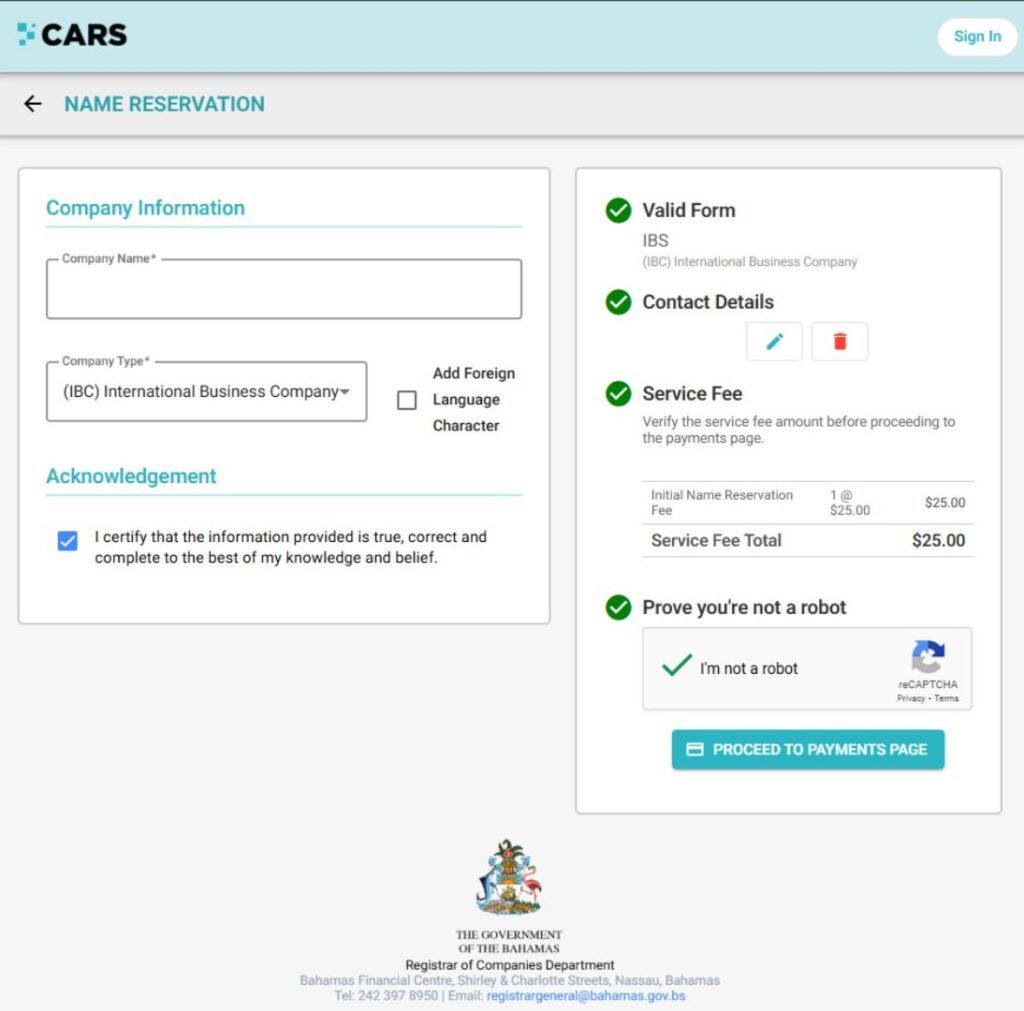
Choose a unique name for your business and reserve it. Your agent may do so on the Bahamian government’s Corporate Administrative Registry Services (C.A.R.S.) website.
The government fee is USD25.
Step 4 – Submit company details and incorporation form online
This filing can only be completed by a licensed Financial & Corporate Service Provider (i.e. your agent), who will also pay the incorporation fee on your behalf.
For IBCs with an authorised capital below USD50,000, the incorporation fee is USD400.
Step 5 – Print company documents
In around 48 hours, the company will be incorporated, and the company documents will be issued.
The information above is based on the International Business Company (Amendment) Act, 2014.
The challenges of forming a Bahamas corporation
Even the most attractive options come at a price, and the same can be said of incorporating a company in a thriving tax haven like the Bahamas.
Substance Requirements
To prevent tax avoidance through profit shifting, the Bahamian government passed the Commercial Entities (Substance Requirements) Act in 2023. This requires IBCs engaging in “relevant activities” to show that they are conducting profit-generating operations within the Bahamas.
“Relevant activities” include:
- (a) banking business;
- (b) insurance business;
- (c) fund management business;
- (d) financing and leasing business;
- (e) headquarters business;
- (f) Distribution and service centres business;
- (g) shipping business;
- (h) Commercial use of intellectual property;
- (i) Holding business, but does not include the business of operating an investment fund.
In effect, the Act requires that IBCs engaging in the activities above manage the business from the Bahamas, hire in the Bahamas, and set up physical offices on the islands.
Reputational Risks: The Bahamas Leaks
In 2016, the International Consortium of Investigative Journalists (ICIJ) publicly released information on over 175,000 companies, trusts and foundations registered in the Bahamas. This information became known as the Bahamas Leaks.
The leaks revealed that multiple high-profile political personalities have hidden offshore links in the Bahamas, often contravening codes of conduct that govern politicians. Among them is former EU commissioner Neelie Kroes. In serving as a director of a Bahamas company, Kroes violated the Code of Conduct for Commissioners, which forbids Commissioners from engaging in any other professional activity.
The Bahamas has long had a reputation for secrecy and illicitness, and the leaks have only reinforced that reputation.
And this is why, though the Bahamas welcomes foreign entrepreneurs with open arms, they should nonetheless consider if the region offers a solid enough foundation for their next ventures. However, the Bahamas is certainly not the only tax haven in the world. To make an informed choice on where to form your next business, check out our comparative study on the 5 strongest tax havens in the world.
Frequently Asked Questions about collection of personal data
1. Can a foreigner open a company in the Bahamas?
Yes, foreigners can open a company in the Bahamas, but they are required by Bahamian company law to do so through a registered agent in the Bahamas. As specified in International Business Companies (IBC) legislation, only attorneys, public accountants licensed under the Public Accountants Act, or bank or trust companies licensed under the Banks and Trust Companies Regulation Act are qualified to act as agents.
2. How to form a company in the Bahamas?
Company can be formed completely online at the government’s electronic portal (the CARS Online Public Services Portal). To register an IBC online, you must engage the services of a registered agent in the Bahamas, as the government stipulates that filings must be completed by the said agent.
3. How much does it cost to set up a company in the Bahamas?
Foreigners must engage the services of registered agents in the Bahamas to set up an IBC, so the cost of setting up a company in the region comprises the fees charged by the agent and the government fees. Though fees can vary from agent to agent, government fees follow a set fee schedule. For a company with a share capital under USD50,000, the government incorporation fee is USD400, and for a company with a share capital above USD50,000, the government incorporation fee is USD1,200.
4. Why do companies register in the Bahamas?
Many entrepreneurs register their companies in the Bahamas due to favourable tax laws in the region. The Bahamas’s government levies no corporate tax, income tax, inheritance tax, and sales tax on IBCs. In addition, the island is also known for its straightforward company law, relaxed reporting requirements, and the privacy it provides to UBOs. This is why the region remains a popular choice for entrepreneurs who wish to save time on compliance and focus on developing their businesses.
Should you not find the answer to your question in our Incorporation FAQ, please do not hesitate to let us know by emailing us at incorporation@getstarted.hk and we will be happy to assist you.