
Contents
Core Insights
- CNAPS code is a 12-digit identification code created by the People’s Bank of China.
- CNAPS has an extensive business transaction system called HVPS (High-Value Payment System) and a standard small payment system called BEPS (Bulk Entry Payment System)
- CNAPS is a primary domestic payment system developed by China, whereas CIPS (China International Payment System) is designed for international transactions.
- CNAPS can be found on bank documents or external websites, such as https://cnaps-code.com/, which is utilized as a CNAPS search engine for users outside China.
What’s a CNAPS code?
The CNAPS code is China’s National Advanced Payment System code, developed by the People’s Bank of China to improve fund transfers and payment clearing. It is a 12-digit number unique to each bank branch in China, denominated in Chinese Yuan (CNY).
The code must be included in every CNY transaction, including those of foreign banks operating in China. Its purpose is similar to SWIFT codes used internationally or the sort code used in the UK.
Components of CNAPS Codes
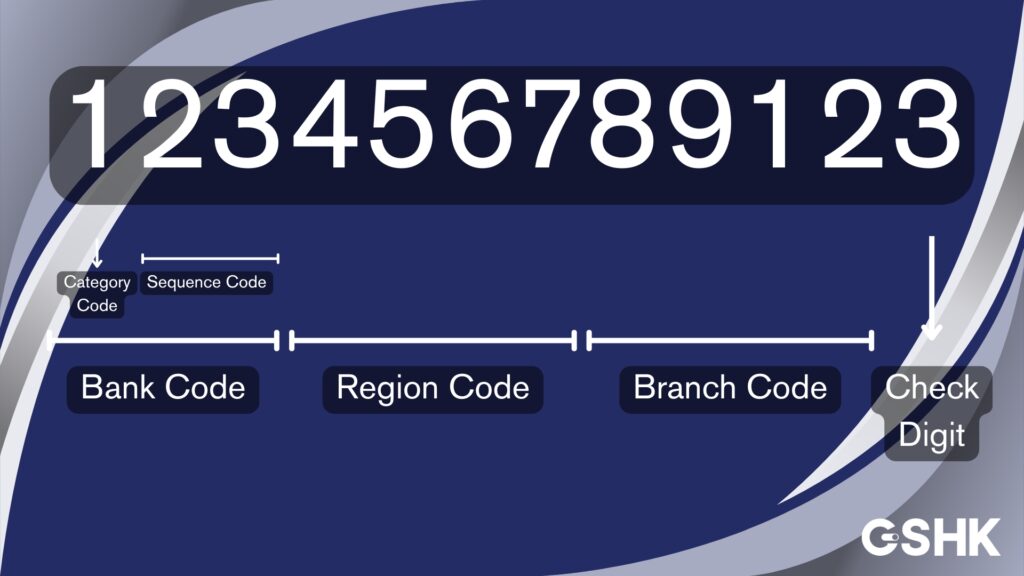
A CNAPS code consists of 12 digits arranged in the following format: ABBCCCCDDDDX. The code has a specific digit to identify a bank and its branch location in different cities and provinces. One example can be the CNAPS code of HSBC Bank (China) Company Limited, specifically the Beijing Branch, which is identifiable as 501100000011.
The first three digits of the series of numbers are the Bank Code. This includes a Category Code (first digit), mainly used to identify the type of bank, such as state-owned or foreign banks, followed by a two-digit Sequence Code that identifies the specific bank. Thus, “501” is the code for HSBC Bank China. The next four digits represent the City or District Code. Therefore, “1000” refers to the Beijing district code. The following four digits reflect the Branch Code, which in this case is “0001,” and identify the specific branch of the bank in that area. The last digit, “1,” is used as a verification or unique identifier, ensuring the correctness of the CNAPS code.
Purpose and Importance
CNAPS codes play an important role in processing domestic RMB payments in China. When sending payments, the sender bank takes the recipient bank’s CNAPS code and directs the money directly through the China National Advanced Payment System.
This ensures that using CNAPS codes leads to greater efficiency, fewer mistakes, minimal incorrect routing, and prompt delivery of funds to the intended recipient. These codes serve the same purpose as routing numbers in the US or sort codes in the UK, serving as the primary identification system for all financial transfers within mainland China.
CNAPS vs. International Systems
Unlike SWIFT and others, China’s domestic payment system is not suitable for cross-border transactions in various currencies, as it is primarily designed for domestic RMB payments. On the other hand, SWIFT is a global system that facilitates cross-border transactions involving foreign currencies.
This was mainly due to the Chinese government’s reform of the country’s market in the 1980s. Since then, the country has experienced significant economic growth by allowing foreign investments to flow in. To manage transactions resulting from this growth, CNAPS and CIPS (China International Payment System) were established to handle local and foreign transactions entering China, respectively.
The People’s Bank of China operates two subsystems of CNAPS: CNAPS-HVPS (High-Value Payment System) for large-value transactions conducted in real-time across over 800 cities, and CNAPS-BEPS (Bulk-Entry Payment System) for smaller batch payments.
CNAPS-BEPS is similar to Automated Clearing House (ACH) used in the US, which processes smaller payments within the same day.
How to find CNAPS Codes
The best and easiest way to find CNAPS codes is to ask the recipient directly. The banks in China will provide this information when requested. However, overcoming the language barrier can be a significant challenge. You can find the CNAPS codes for your bank on the bank documents and website.
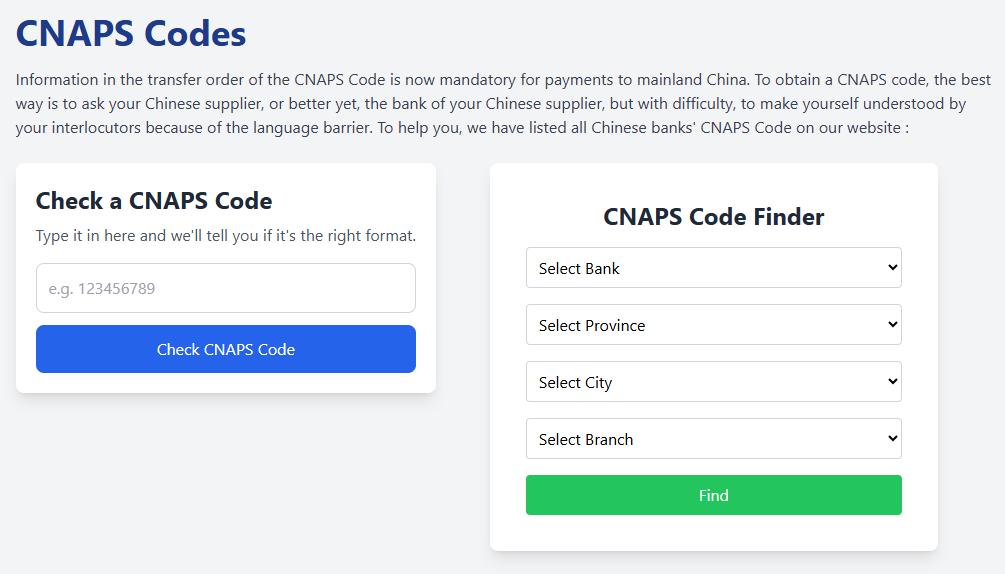
Alternatively, you can easily find the CNAPS codes from websites designed explicitly for CNAPS codes. Sites like https://cnaps-code.com/ provide full access to finding the code via their code finder and code processor. This service will save time and easily overcome language barriers, as the website is designed in English.
Conclusion
CNAPS codes are becoming a basic necessity in China’s modern payment landscape. Firms involved in Chinese banking transactions, particularly in the domestic RMB currency market, must be familiar with CNAPS and its proper application to facilitate efficient business dealings.
Frequently Asked Questions about collection of personal data
You will not need a CNAPS code if you don’t have ongoing domestic financial transactions in China.
2. How can I find the CNAPS codes of other banks?
You can inquire at banks in China, but our recommended solution is to use an external search engine specifically designed for CNAPS codes, such as https://cnaps-code.com/.
3. How is CNAPS different from SWIFT?
CNAPS is used only for domestic RMB payments within mainland China. SWIFT is an international system for cross-border payments in multiple currencies.
4. Can foreign banks in China use CNAPS codes?
Yes, all banks operating in China, including foreign banks, use CNAPS codes for domestic RMB transactions.