Contents
Key Takeaways
- What is Billing? Bills are used to request immediate payment for services provided, primarily in business-to-customer transactions.
- What is an Invoice? Invoices serve as a legally binding document to track the amount of money owed by two businesses, as well as the goods and services provided.
- Billing and invoicing differ primarily in their intended uses.
- Bills and Invoices are often used interchangeably, but many people confuse them, which can cause problems with their accounting records.
Handling payments is one of the most critical tasks in business operations and accounting, and it can be a complex and challenging area to navigate. Simple errors can cause catastrophic problems, and basic accounting and bookkeeping terms like ‘Billing’ and ‘Invoicing’ can sometimes become confusing.
Billing and invoicing can often be used interchangeably, which has tangled their meanings and uses. Both are crucial for tracking payments in business operations and minimising discrepancies. Understanding their definitions, uses, and differences can help reduce errors and improve overall business efficiency and operations.
This article clarifies the basics of bills and invoices, explains their differences, and outlines how they impact business operations, as well as when to use them.
Invoice and Bill: The Basics
Before delving deeper into the world of billing and invoicing, it is essential to understand the basics of what invoices and bills are. Both terms are often used interchangeably, leading people to believe they are the same thing. In the basics, we will dive deeper into what a bill and an invoice are.
Bills are typically issued for immediate payment and provide a simplified way to make payments, as well as a record of transactions. Bills are often settled on the day of issuance, making it a more efficient way for transactions between Business-to-Customer (B2C) entities. Imagine you own a restaurant in Hong Kong. Customers who have finished dining will need to pay for the food and service they have received. Providing them with a bill will be the right choice, as you expect payment for your food and service immediately.
Invoices, on the other hand, are often used for a prolonged period for payment. Invoices are a more formal document that’s used for business-to-business (B2B) settings. An invoice contains complete details of the goods and services provided by the seller to the customer, listing all relevant information such as price, quantities, mode of payment, and terms associated with this agreement. Invoices are often issued with an agreed-upon payment term, which indicates the date by which payment is due. Invoices are frequently used in scenarios such as a supplier issuing an invoice to a retailer for the goods they provide, stating the payment terms, price, and quantities provided.
Billing vs Invoicing: What’s the Difference?
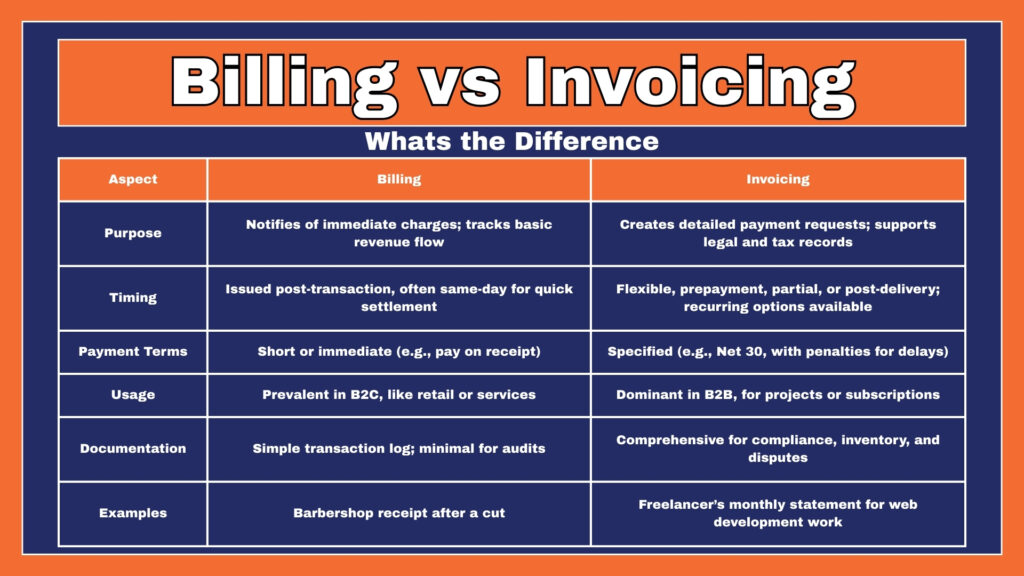
To accurately utilise billing and invoicing in bookkeeping and accounting, we must understand the distinction between the two. Both Billing and invoicing are crucial aspects of the accounting process. The table below outlines the key elements and main differences between the two forms:
What is Billing?
What is Billing in general? Billing is just the basic process of requesting payment after a transaction has occurred. Think of it as a notice that alerts people to the requirement to pay as soon as possible. Billing in accounting and bookkeeping tracks the amount of cash flow coming in with minimal time discrepancies. This makes billing a standard procedure and an integral part of bookkeeping ledgers.
In everyday business transactions, seeing a “pay now” sign is often, if not always, a sign of billing. Some common examples of this are:
- The electric company sends out monthly bills to businesses or individuals via mail or email, which are due upon receipt.
- A subscription that is due monthly for payment. It is often required to be paid on the same day of each month.
This makes it an ideal method for requesting payments in business-to-customer (B2C) situations where an immediate payment is required. Billing makes the transaction easy and quick. Based on our experiences, most of our clients tend to open retail-related businesses. Using this as an example, the Point of Sale (POS) system of a retail business would automatically track inventory, manage sales, and process transactions. The system would automatically process a bill and input it into the daily sales report for the business. This will maintain a steady cash flow for the company.
What is Invoicing?
When transactions become complicated, that’s where invoicing steps in. Invoicing is a process that requires proactive involvement in creating a detailed payment request, down to the last decimal point. An invoice is a formal, detailed document that lists all the goods and services provided, along with the total amount due and the method of payment. This makes invoices a crucial part of tax records for auditing purposes.
Invoicing is a crucial aspect of a business-to-business (B2B) setting due to its importance. It’s a legal agreement between both parties, binding them to the invoice and may be enforced in court.
- It often includes the allotted payment terms, such as Net 30, 60, or 90, which indicate when it is due.
- It also provides supporting details such as late fees, an option to pay via instalments, references for purchase orders, delivery dates, and VAT breakdowns.
An example of this can be when you, as a restaurant owner, order raw materials for your restaurant from your suppliers. Each supplier will prepare an invoice showing all the details above, along with a discount for payment made before the due date. The invoice will then be entered into the general ledger in accounting to facilitate audits and track inventory changes. An invoice is more than just a payment request; it functions as a tool that helps you maintain your financial records and maintain the quality of operations in the long run.
Final Notes
Both billing and invoicing contribute to the business’s cash flow. The primary difference lies in how and when the cash flows into the business. Billing is used for quick business-to-customer transactions and notifications, while invoicing is utilised for long-term business-to-business contracts. While billing is used for paying bills on a daily basis, invoicing is employed to establish a strong foundation for the business’s future.
Confusion between the two may lead to money tracking problems. If you’re unsure about what you are doing, just let us help. Contact our agency today, and our accountants will help you get started and manage your business effectively. Contact us now at info@getstarted.hk to learn more about our services.
Frequently Asked Questions about collection of personal data
An invoice is a detailed document that includes payment terms and serves as a legally binding agreement between two businesses.
Invoicing is just the issuance of an invoice to a business for the service or goods you have provided, stating the terms and conditions, payment terms, quantity of goods, and payment due.
Billing is the process of issuing a bill to notify customers to make an immediate payment for the goods and services you have provided.
No, an invoice and a bill are not the same. An invoice is a formal request for payment for the goods and services provided, outlining the terms of payment and other details to ensure accurate records. Bills, on the other hand, are primarily used to request immediate payment from customers.