
Contents
Key Takeaways
- GST for freelancers is a tax that freelancers providers collect from their customers and then forward to the government.
- Service tax for freelancers in India is applicable if their annual turnover exceeds Rs. 20 lakh and if the service provided falls under Online Information and Database Access Retrieval Services. However, voluntary GST registration to claim ITC is also permissible
- Freelancer tax in India is 18% for most goods and services
- GST registration for freelancers in India may be done online through the Indian government’s GST Portal
Freelancers from all over the world come to Hong Kong to start one-person companies, to enjoy limited liability protection and craft a more professional image for their businesses. If their profit-generating activities don’t take place in Hong Kong, they can even enjoy all these benefits while being free from HK taxes.
However, freelancers should note that, just because they’re free from Hong Kong taxes, doesn’t mean that they don’t have to pay taxes to the countries where they provide services. As our freelancer clients in India are well aware, even one-person Hong Kong companies operating in India are subject to a Goods and Services Tax (GST).
As India is only one among many other countries that levies GST, understanding how GST works in India provides a good introduction to navigating GST in other countries.
What is GST for freelancers?
GST is a tax that you charge your customers in your invoices. Your responsibility as a freelancer is to collect this tax on the government’s behalf and then forward this tax to the government when filing GST returns.
Freelancer tax in India – Who needs to register?
Freelancers must register for GST in India under these scenarios:
- Freelancer based India, providing services to Indian customers
- Freelancer outside of India, selling goods and services to Indian customers
- Annual turnover exceeds Rs. 20 lakh (Rs. 10 lakh for special category states, i.e. states granted special status due to their geographical and socio-economic disadvantages).
- They offer Online Information and Database Access Retrieval Services (OIDAR) (services provided through the internet without physical interface between the supplier and the recipient of the service). These services might include:
- Digital marketing
- Content writing
- Software development
Freelancers may opt out of GST registration if their annual turnover is under Rs. 20 Lakh, provided that they do not deal with OIDAR services.
(source → this source says interstate services are definitely taxable even if the freelancer’s annual turnover falls below the threshold, but this is outdated, according to this source. Can scroll to “No Mandatory Registration in case of interstate services by Freelancers”)
Voluntary Registration
Even if you earn under Rs. 20 lakh, per year, you may still register for GST. Doing so would enable you to claim GST on business expenses.
This is especially a significant advantage if GST is cutting into your company’s profits. For example, your company pays 18% GST to a digital marketing firm to advertise your services to your customers. Registering for GST might make you eligible for claiming that amount as Input Tax Credit (ITC).
Rates of service tax for freelancers in India

Below are some of the services for which freelancers must charge GST from Indian customers:
| Service Type | GST rate |
| Photography & Graphic Design | 18% |
| OIDAR | 18% |
| Supply consisting of E-book only (OIDAR) | 5% |
| Training, Coaching, and Educational Services | 18% |
| Digital Marketing, Content Writing, & SEO | 18% |
| Business Consultancy | 18% |
| IT services (e.g. Software and app development ) | 18% |
| Audio conferencing and video conferencing over the Internet | 18’% |
| Accounting & Bookkeeping services | 18% |
What is charged 0% GST in India?
Here are some of the business-related expenses that freelancers registered under GST may claim ITC:
- Office equipment (e.g. Laptops)
- Internet bills
- Software
- Software subscriptions (e.g. Canva, Photoshop)
You are also not required to charge GST for export of services, that is, if your clients are located outside of India. To do so, you simply file a Letter of Undertaking to the Indian government.
Before filing the letter of undertaking, freelancers must fulfil the following conditions:
- They must be located in India
- Their clients must be located outside of India
- Their payments must be received in a convertible foreign currency.
How to register for GST for freelancers in India?
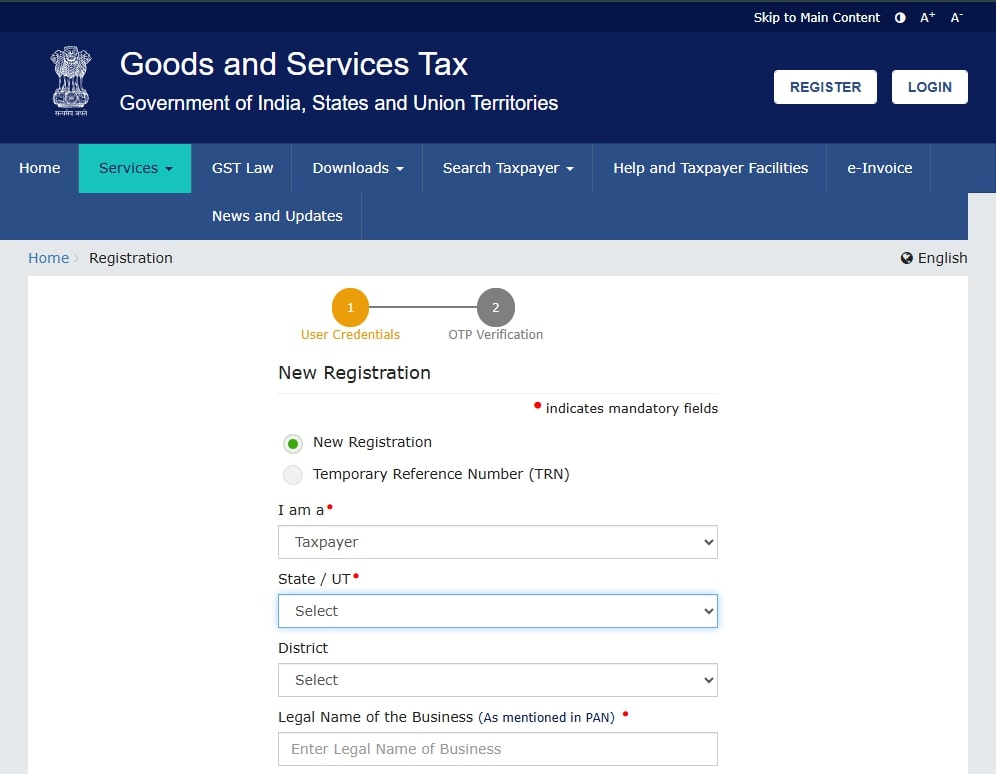
GST registration in India can be done completely online in a few simple steps:
- Visit the GST portal (https://www.gst.gov.in/) and select “Register” > “Tax Payer”’
- Fill in details such as your state and your business’s legal name, and services offered
- Upload the necessary documents and submit the application
- Once verified, you’ll receive your own GST Identification Number (GSTIN) in 7-10 days
GST for freelancers in India: In practice
Invoice rules
Freelancers who have completed GST registration must include the following in their invoices:
- Freelancer’s details
- Company Name (if incorporated)/ personal name
- Address
- the freelancer’s GSTIN
- Invoice number and date
- Client’s details
- Name
- Address
- GSTIN (if applicable)
- The corresponding GST rate and amount
- Total invoice value
Filing GST returns
The following GST returns are mandatory for registered freelancers:
| Return Type | Filing Frequency | Details to be submitted |
| GSTR-1 | Monthly or quarterly | Summary of all sales (issued invoices) of a taxpayer. |
| GSTR-3B | Monthly | Details of sales, ITC claims, tax liability, refunds |
| GSTR-9 | Annually | Details of sales, purchases and GST charged and paid within the financial year |
**Late filing can result in penalties.
As we’ve seen, GST rules aren’t always complicated. Indeed, the registration process can be done in a few clicks, in a few days, and claiming ITC is a considerable benefit of registering for GST, regardless of whether your annual turnover exceeds the threshold. Understanding GST regulations in your place of operations is the best way to ensure that compliance matters don’t erode the freedom and flexibility you enjoy as a freelancer.
Frequently Asked Questions about collection of personal data
1. Is GST applicable on freelancers?
Generally speaking, GST is applicable on freelancers if their income exceeds a certain threshold and if they are providing services to customers in a jurisdiction that levies GST. In India, in particular, freelancers with Indian customers, whose annual turnover Rs. 20 lakh, must register for GST.
A GST applies to most goods and services in India. The most common services provided by freelancers include photography and design services, training services, digital marketing services, business consultancy services, and IT services. The GST rate for all of these services is 18%, provided that they are provided to customers within India.
First, Indian freelancers must register for GST. This can be done completely online. Once the application is submitted, the applicant will receive a GSTIN within 7-10 days. Once registered, the freelancer must comply with GST regulations, which entails filing the GST returns forms GSTR-1, GSTR-3B, and GSTR-9. The first two are filed on a monthly basis, while the final form is filed on an annual basis.
4. Who is not required to pay GST?
In India, freelancers whose annual turnover falls below Rs. 20 lakh are not required to register for and charge GST. For freelancers in the hilly and northeastern states, this threshold is lowered to Rs. 10 lakh to address regional challenges. Freelancers who sell services to customers outside of India may also submit a Letter of Undertaking to exempt themselves from charging GST.