Contents
- Big Brands Can Mock Each Other (SMEs Cannot)
- SMEs Are Not Corporations — They Are Personal
- The Hong Kong Transparency Problem: You Don’t Know Who You’re Provoking
- A Real Example: When Competitors Push Too Far
- Conclusion: AI Helps You Plan, But Only Humans Understand the Consequences
- Get Started HK: Authority in the Startup Ecosystem
- FAQ Section
AI can analyse thousands of marketing campaigns, compare strategies, and even suggest what an entrepreneur should do to grow a business. It can break down the pros and cons of comparison ads, competitor bidding, or aggressive positioning. But there is one thing AI will never understand, the human ego behind SME competition, especially in Hong Kong.
As someone who has built GetStarted.hk from zero, helped thousands of entrepreneurs with Hong Kong company formation and company registration, and seen the real emotions behind SME rivalry, I can tell you this clearly:
Marketing strategy is logical.
Human reaction is not.
And this is exactly where AI fails.
Big Brands Can Mock Each Other (SMEs Cannot)
AI loves to reference famous “brand wars”:
- McDonald’s vs Burger King
- Pepsi vs Coca-Cola
- Samsung vs Apple
These campaigns are fun, playful, and often go viral. But there’s a reason they work:
Both companies are huge.
Both founders are not personally involved.
Both brands will still make billions regardless of the joke.
It’s a game.
A show.
A marketing performance.
The Pepsi vs Coca-Cola Examples AI Loves to Quote
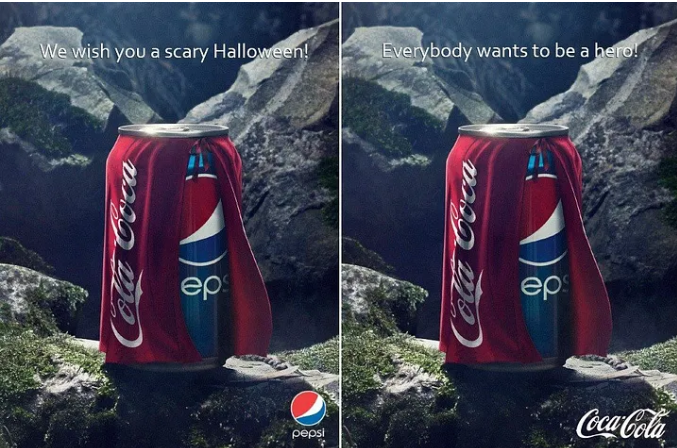
Take Pepsi’s legendary Halloween ad:
- A Pepsi can wear a Coca-Cola cape.
- The tagline: “We wish you a scary Halloween.”
Coca-Cola responds with: “Everyone wants to be a hero.”
It’s witty.
It’s harmless.
Nobody gets hurt.
Or the classic vending machine ad:
- A kid buys two cans of Coca-Cola.
- He places them on the ground.
- Steps on them to reach the Pepsi button.
- Buys a Pepsi.
Walks away.
Watch it here:
Coca-Cola gets “stepped on”, but nobody takes it personally.
Because these brands are corporate giants, not emotional founders.
But when Samsung mocks Apple today, the tone feels different. It doesn’t feel like two giants having fun. It feels like one brand is trying too hard to pull the other down. The energy is off. The intention feels insecure.
And that’s the difference AI cannot detect, the emotional tone behind the message.
SMEs Are Not Corporations — They Are Personal
When you run a small or medium enterprise in Hong Kong, your company is not just a business.
It is your baby, your identity, your life’s work.
You spent years building it.
You sacrificed weekends, sleep, and stability.
You poured your heart into it.
So when a competitor uses comparison marketing,
placing Google Ads on your brand name,
writing “comparison reviews”,
putting a booth next to yours,
or even mocking your services.
AI will tell you:
“Don’t take it personally. It’s just marketing.”
But entrepreneurs know the truth:
It is personal.
If Someone Insults Your Baby, You Don’t Smile, You React
Imagine someone standing next to your newborn baby and saying:
- “Your baby looks like shit.”
- “Her fingers look weird.”
- “His face looks strange.”
- “My baby is stronger, prettier, better than yours.”
You’re not going to say,
“Oh wow, thank you for the feedback.”
You’re going to react like any parent would.
Because they’re not just insulting your baby, they’re insulting you, your effort, your identity.
This is exactly how SME founders feel when competitors attack them.
And this is the part AI will never understand.
The Hong Kong Transparency Problem: You Don’t Know Who You’re Provoking
In the UK, Singapore, or many Western markets, you can easily search company information online.
You can see the director, shareholder, and ownership structure instantly.
But Hong Kong is different.
- You cannot freely search director or shareholder information on Google.
- You must make a formal declaration to the Companies Registry.
- You must be a related party to conduct certain searches.
- Even then, you only see partial shareholder information.
- Many companies use corporate shareholders to shield the real owners entirely.
This means:
You never know who you are provoking.
And it’s not just about money.
**You don’t know if the founder has deep pockets.
You don’t know if they have organisational backing.
You don’t know if they have community support.**
Some SMEs are backed by:
- family offices,
- powerful associations,
- wealthy communities,
- or investors who prefer to stay invisible.
You think you’re attacking a small company.
But behind that company could be someone who:
- refuses to lose,
- has unlimited budget,
- or has a whole network ready to support them.
AI cannot warn you about this.
AI cannot tell you who is behind the company.
AI cannot predict how angry a founder will get.
Only humans understand this risk.

A Real Example: When Competitors Push Too Far
At GetStarted.hk, we originally tried to behave like Apple, calm, cool, and unbothered.
We ignored provocation.
We didn’t respond to comparison ads.
We stayed focused on our service quality in Hong Kong company formation and company registration.
But some competitors kept pushing.
They placed ads on our brand name.
They set up booths next to ours.
They tried to ride on our traffic, our reputation, our hard work.
Eventually, we responded, not because AI told us to, but because we are human.
Wherever they put a booth, we put one too – for free.
If they bid on our brand, we doubled the bid.
If they tried to overshadow us, we overshadowed them.
Not because it was “strategic”.
But because founders don’t like being disrespected.
And here’s the part most SMEs never calculate – the real cost of starting a war
We are not saying comparison marketing is always wrong.
If you are absolutely certain the other side will not fight back, then yes, you can do it.
But here is the reality most SMEs ignore:
**If you spend $5,000 on Google Ads targeting your competitor’s brand name…
and they fight back with $10,000 on your brand name…
you now must spend $15,000 just to defend your own brand.**
Suddenly, your own brand name, which used to rank organically, is buried under your competitor’s ads.
That extra $15,000 could have been used to:
- improve your service quality,
- hire another customer support staff,
- build better systems,
- or even pay yourself dividends.
But once you start a war, even if you apologise later, nobody will take the apology seriously.
If the other party has deep pockets, they will make sure you pay for the lesson, so no one dares to repeat the bad‑faith tactic again.
So before you start such a war, ask yourself:
Is it worth spending money on your competitor just to capture their attention and provoke retaliation?
If you are Coca-Cola or Pepsi, a giant corporation with an unlimited budget, fine.
If you are a structured multinational that doesn’t care about money, fine.
But if you are an SME relying on investor funds, especially if you are already operating at a loss, attacking the industry leader is the worst decision you can make.
Sometimes staying quiet earns you slow, steady profit.
Starting a war guarantees a double loss.
Conclusion: AI Helps You Plan, But Only Humans Understand the Consequences
AI can help you analyse marketing strategies.
AI can help you optimise campaigns.
AI can help you plan.
But AI cannot understand:
- founder pride,
- emotional retaliation,
- hidden backers,
- Hong Kong’s low transparency,
- or the real financial cost of provoking the wrong competitor.
Marketing wars are not fought by algorithms.
They are fought by humans, with emotions, ego, and identity.
And that is something AI will never tell you.
Get Started HK: Authority in the Startup Ecosystem
At Get Started HK, we’ve helped over 46,000 entrepreneurs build companies, navigate Hong Kong company formation, and grow sustainably in a competitive market.
We don’t just understand the legal and operational side of business, we understand the human side. And that is why founders trust us.
FAQ Section
Q1: Why do comparison ads work for big brands but not for SMEs?
Because big brands like Pepsi and Coca-Cola are not emotionally attached to the business. Their founders are not involved, and both companies will still make billions regardless of the joke. SMEs, however, are built by founders who treat the company like their baby. Any attack feels personal, not playful.
Q2: Is it safe for SMEs to bid on competitor brand names in Google Ads?
Only if you are 100 percent certain the competitor will not fight back. If they retaliate, your cost to defend your own brand name can multiply instantly, turning a small experiment into a financial war.
Q3: Why is Hong Kong’s business environment more sensitive to marketing attacks?
Hong Kong has low transparency. You cannot freely search shareholder or director information. Many companies use corporate shareholders to hide ownership. You never know who you are provoking, how deep their pockets are, or what organisations or communities back them.
Q4: What is the biggest risk of starting a marketing war as an SME?
You may trigger retaliation from a competitor with more resources, more community support, or more emotional motivation to fight back. Once the war starts, even an apology cannot undo the damage.
Q5: When is comparison marketing acceptable?
If you are a large corporation with unlimited budget, or if you are absolutely certain the other side will not respond. For SMEs, it is usually not worth the risk.
Image Source: Magnific