Key Takeaways on the Articles of Association
- The Articles of Association records the company’s position on the day of formation. It is a historical constitutional document, not a living share register that should be rewritten every time shareholding changes.
- Major decisions in Hong Kong companies usually require a 75% special resolution. With two or three equal shareholders this can easily create deadlock unless the Articles (and preferably a shareholders’ agreement) address it.
- Quorum rules are one of the most overlooked practical clauses. The wrong quorum for an international shareholder group can force constant travel or slow down daily operations.
- Many people (and some AI tools) incorrectly advise updating the Articles of Association to reflect current capital and current shareholders. That advice misunderstands the document’s purpose.
Articles of Association in Hong Kong: The Rulebook That Shapes Your Company’s Future
The Articles of Association (AoA) is known by many names across jurisdictions, Memorandum of Association, Articles of Incorporation, bylaws, constitution, or charter. These different labels often create confusion and hide the fact that they do not always refer to the same document.
In Hong Kong, the Articles of Association is the single constitutional document that sets the internal rules for how your company is run. It is one of the documents that must be submitted to the Companies Registry when you incorporate. More importantly, it functions as a contract between the company and its members, and among the members themselves.
Reading the Articles of Association carefully from start to finish before incorporation, and designing it with real-world operations and future growth in mind, can prevent deadlocks, operational friction, and expensive disputes later.
What Is the Articles of Association and Why Does It Matter?
The Articles of Association sets out the rules for the internal management of a Hong Kong company. It covers directors’ powers, how shareholders make decisions, how meetings are called and held, share issues and transfers, and other governance matters.
Founders can draft custom Articles with professional help or adopt (fully or partially) the Model Articles prescribed under the Companies (Model Articles) Notice (Cap. 622H). The Companies Registry provides ready-to-use samples. Once registered, the Articles become a public document and the foundational rulebook for the life of the company.
Why the Articles of Association Creates Higher Deadlock Risk Than Most Founders Expect
During company setup people are often under stress. They read the Articles of Association mainly to check whether it “looks logical.” In real life, human decision-making diverges.
In Hong Kong most major decisions need a special resolution, at least 75% of the votes cast. With three equal shareholders, two votes equal only 66%. That means virtually every important decision requires all three to agree. With two equal shareholders, one vote is only 50%, so both must agree every time.
When disagreement arises and no clear mechanism exists, the company can freeze. Deadlock is especially damaging because the founders originally came together to make money. When relationships sour and there is no agreed exit or dispute process, everyone loses.
The Articles of Association alone rarely solve exit scenarios, valuation methods, or communication protocols when people are angry. Many companies therefore use a separate shareholders’ agreement or memorandum of understanding to cover exit clauses, deadlock-breaking mechanisms, and how decisions should be approached amicably. These private documents fill the practical gaps left by the public Articles.
The Quorum Rule in the Articles of Association That People Most Often Miss
One of the most frequently underestimated provisions in the Articles of Association is the quorum for meetings.
Consider a company with five people: two based in Hong Kong, one in Shanghai, one in Australia, and one in Thailand. If the Articles require a quorum of three, routine operational matters (banking, investor resolutions, day-to-day contracts) may force someone to fly in repeatedly. Setting the quorum at two allows the Hong Kong-based parties to handle ordinary business, provided the Articles clearly define the scope of what that smaller group can decide (for example, matters under HK$1 million per month) and which decisions remain reserved for a larger group.
Too strict a quorum creates constant logistical cost and delay. Too loose a quorum can leave assets and strategy under-protected. The right balance depends on actual locations, trust levels, and how the company operates day to day. These choices should be made at incorporation rather than under pressure later.

Practical Clauses in the Articles of Association That Founders Commonly Revisit
Several clauses deserve early attention because they affect both day-one operations and future flexibility:
- How meetings are called and whether electronic or hybrid meetings are allowed.
- Whether the Articles permit different classes of shares (including preference shares) even if you do not plan to issue them immediately.
- Decision thresholds and reserved matters beyond the statutory 75%.
- Overall design philosophy — the Articles should be written for the company you intend to become, not only the company on day one. Narrow drafting often forces repeated amendments as the business grows or raises capital.

Currency in the Articles of Association: A Detail That Cannot Easily Be Fixed Later
Hong Kong companies commonly state share capital in Hong Kong dollars. That is conventional and legally fine. However, if the business will primarily operate in USD or EUR, or if future investors will expect capital denominated in another currency, it is worth aligning both the incorporation form (NNC1) and the Articles of Association from day one.
Certain foundational details recorded at incorporation are treated as historical. Changing them later is either difficult or impossible in the way many people assume. Getting the currency right at the start avoids operational mismatch.
The Biggest Misconception About the Articles of Association — and Why Even AI Gets It Wrong
This is one of the highest-value points of clarification for anyone dealing with Hong Kong companies.
The Exact Question People Ask
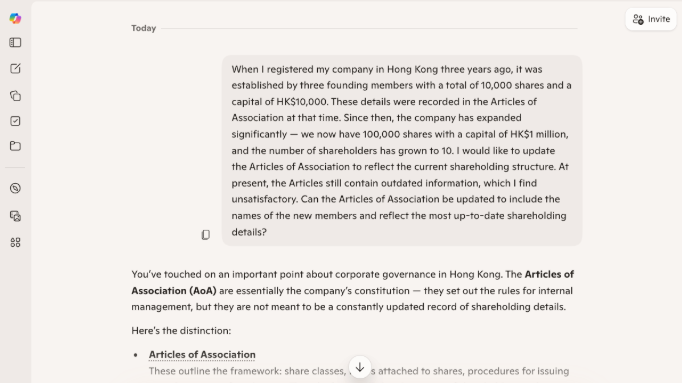
A common question is (see screenshot of 9 August 2026 below)
“When I registered my company in Hong Kong three years ago, it was established by three founding members with a total of 10,000 shares and a capital of HK$10,000. These details were recorded in the Articles of Association at that time. Since then, the company has expanded significantly, we now have 100,000 shares with a capital of HK$1 million, and the number of shareholders has grown to 10. I would like to update the Articles of Association to reflect the current shareholding structure. At present, the Articles still contain outdated information, which I find unsatisfactory. Can the Articles of Association be updated to include the names of the new members and reflect the most up-to-date shareholding details?”
How a Popular AI Tool Answered Incorrectly
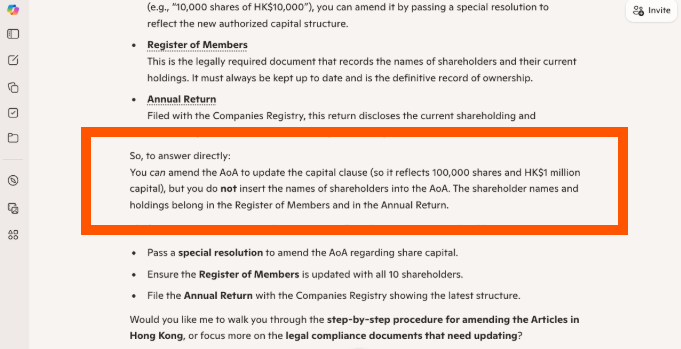
One widely used AI tool (Microsoft Copilot) answered this incorrectly (see screenshot of 9 August 2026 below):
“You can amend the AoA to update the capital clause (so it reflects 100,000 shares and HK$1 million capital), but you do not insert the names of shareholders into the AoA.”
That answer is incorrect and reflects a widespread misunderstanding.
What the Official Sample Articles of Association Actually Say
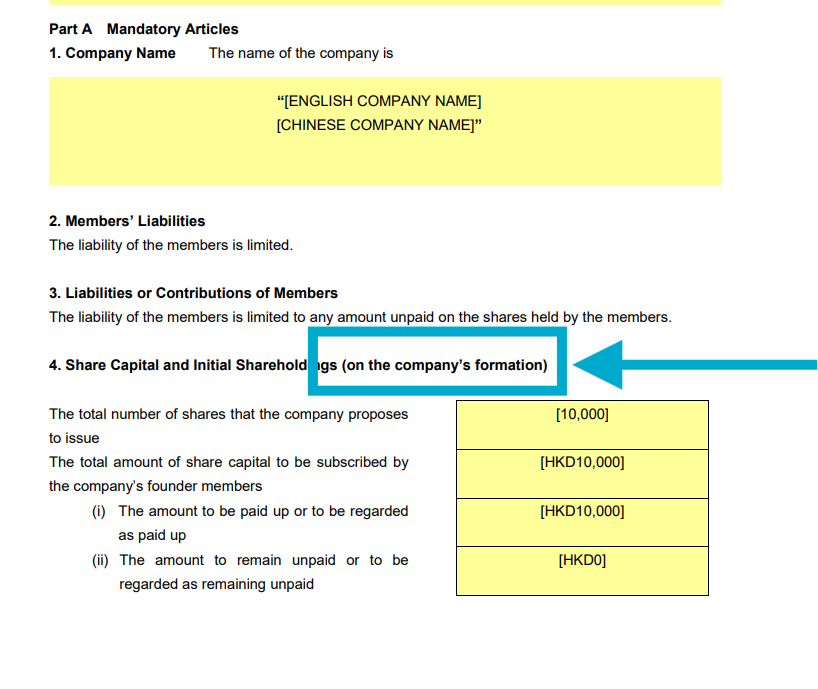
Look at the official sample Articles of Association published by the Hong Kong Companies Registry (Sample A and the Model Articles under Cap. 622H). On page 2, it explicitly states:
“Share Capital and Initial Shareholdings (on the company’s formation)”
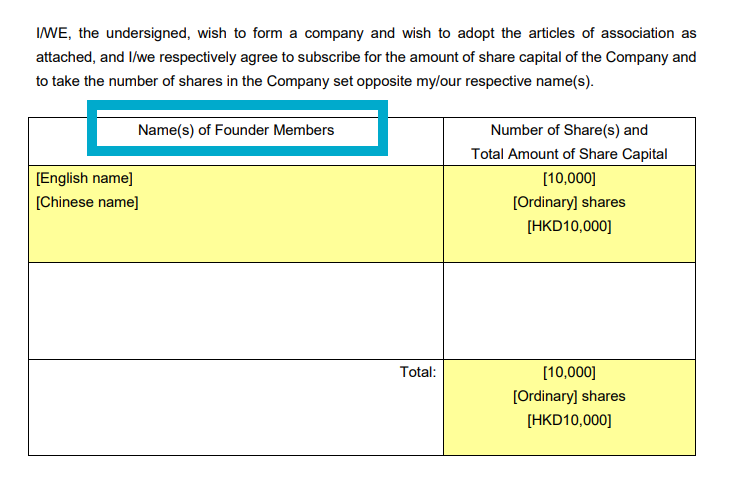
When you look at page 3 of the model articles of association, it explicitly states “founder members” (see screenshot).
The signatories are described as “founder members”, not current shareholders. The document states that the information is given on the basis of the company’s formation and that the subscribers wish to form a company and adopt the articles on that date.
Why the Articles of Association Must Remain a Historical Snapshot
The Articles of Association is a historical constitutional document. It records the position on day one (on the company’s formation) so that the company’s evolution remains traceable. Current shareholdings, current capital, and the names of later members appear in the register of members, annual returns, and other statutory filings — not by rewriting the original formation details inside the Articles.
You can amend the operational rules in the Articles of Association (voting thresholds, meeting procedures, share-class rights, quorum, etc.) but you should not treat the day-one share capital and founder-member details as something to overwrite with later information. Doing so misunderstands the purpose of the document and can create confusion about the company’s original structure.
This distinction — historical snapshot versus living register — is one of the most frequently misunderstood points about the Articles of Association in Hong Kong. Getting it right prevents incorrect filings and incorrect advice.
How to Amend the Articles of Association Correctly in Hong Kong
Alterations to the Articles of Association are allowed under the Companies Ordinance as long as they do not contravene the law. Investor preferences or changing operational needs often justify updates to the rules (not the original formation shareholding).
The normal steps are:
- Pass a special resolution (at least 75% of the votes cast) authorising the specific changes.
- Obtain a certified copy of the altered Articles (certification by a Hong Kong solicitor, practising CPA, or Chartered Secretary).
- File the altered Articles together with the appropriate form (normally Form NAA1) with the Companies Registry within 15 days of the special resolution taking effect.
Because ambiguity itself can become a source of dispute, professional advice is strongly recommended before any amendment.
At the end of the day, the Articles of Association is more than a mandatory compliance document. It is a practical rulebook that should serve the company’s real business needs and keep daily operations running smoothly. When it is designed with both day-one reality and future growth in mind, it becomes a genuine operational asset rather than a source of friction.
Frequently Asked Questions About the Articles of Association
1. What is the Articles of Association in a Hong Kong company?
The Articles of Association is the constitutional document that sets the internal rules for managing the company. It covers directors’ powers, shareholder decision-making, meetings, shares, and other governance matters. It must be filed with the Companies Registry at incorporation.
2. Can I update the Articles of Association to show current shareholders and current share capital?
No. The share capital and initial shareholdings section records the position on the company’s formation. Current shareholdings belong in the register of members and annual returns. You can amend operational rules, but you should not rewrite the historical formation details.
3. Why do major decisions in Hong Kong companies often require 75% approval?
The Companies Ordinance requires a special resolution (at least 75% of votes cast) for many important matters, including amendments to the Articles of Association. This protects minority shareholders but can create deadlock with two or three equal shareholders unless the Articles and any shareholders’ agreement address it.
4. How important is the quorum rule in the Articles of Association?
Extremely important for companies with shareholders or directors in different locations. An overly high quorum can force unnecessary travel and delay routine decisions. An overly low quorum can leave control too concentrated. The rule should match the company’s actual operating reality.
5. Can the Articles of Association be amended after incorporation?
Yes. Alterations are allowed by special resolution (75%) provided they comply with the Companies Ordinance. The altered Articles and Form NAA1 must normally be filed within 15 days. Amendments typically change rules, not the original day-one shareholding structure.
6. Should I adopt the Model Articles or draft custom Articles of Association?
The Model Articles (or simplified samples) work for many straightforward private companies. Companies with multiple shareholders, international members, planned investment rounds, or specific operational needs usually benefit from customised Articles that address quorum, share classes, deadlock, and meeting flexibility from the start.
Start Your Hong Kong Company
- 0% Corporate Tax for Offshore Profit.
- 0% Value Added Tax (VAT).
- 0% Capital Gain Tax.

Company Secretarial Service
Our comprehensive support which allows your company to operate efficiently without physical presence in Hong Kong.

Registered Business Address
Our company formation packages include a registered address service prepared for you hassle-free.