Key Takeaways
- Annual Return Form NAR1 is a point-in-time historical report of a Hong Kong company’s particulars as at its incorporation anniversary date; any changes occurring after that date (such as a renewed passport) must be filed separately on Form ND2B after the NAR1, not inside it.
- Banks in Hong Kong treat Annual Return NAR1 as a core annual due-diligence document. Chronological mismatches or incorrect identification details can trigger enhanced KYC reviews, elevated risk ratings, or account closure.
- Under the Companies Ordinance (Cap. 622), every private company must deliver Form NAR1 within 42 days after its anniversary of incorporation. Late filing attracts escalating fees up to HK$3,480, with no discretionary waiver available, and can lead to prosecution.
- Only companies that have formally applied for and obtained dormant status before the anniversary date are exempt from filing the Annual Return NAR1. Mere inactivity or lack of operations does not qualify as dormancy.
Annual Return in Hong Kong: Why It Matters Far Beyond the Legal Minimum
You may believe that filing the Annual Return (Form NAR1) is simply a statutory obligation under section 662 of the Companies Ordinance (Cap. 622), with the mandatory contents prescribed by section 664. In reality, it is far more consequential.
Banks treat the NAR1 as a critical annual review document. After client onboarding, Hong Kong banks continue rigorous ongoing due diligence, driven by tighter expectations from the Hong Kong Monetary Authority. A clean record on day one does not guarantee the same status a year later. The NAR1 allows banks to check whether new investors have been introduced, whether the share structure or directorship has changed, whether decision-making powers have shifted, and whether identification details (including passport numbers) remain current. Banks cross-reference this information against global systems that flag criminal investigations, money-laundering risks, or other red flags. Incorrect or chronologically inconsistent information signals weak governance and can elevate a company’s risk rating, trigger investigations, or, in serious cases that cannot be adequately explained, result in account closure.
AI vs Professional Company Secretary for Hong Kong Annual Return (NAR1) Filing
On 6 August 2026 we put the same real-world question to Microsoft Copilot and Google Gemini. Both produced answers that were factually incorrect or operationally dangerous. Full screenshots are included below.
Scenario
A company’s anniversary is 2 February. The NAR1 must be filed within 42 days (deadline 16 March). On 2 March the director’s old passport expired and a new passport was issued the same day. Should the new passport details be used in the NAR1?
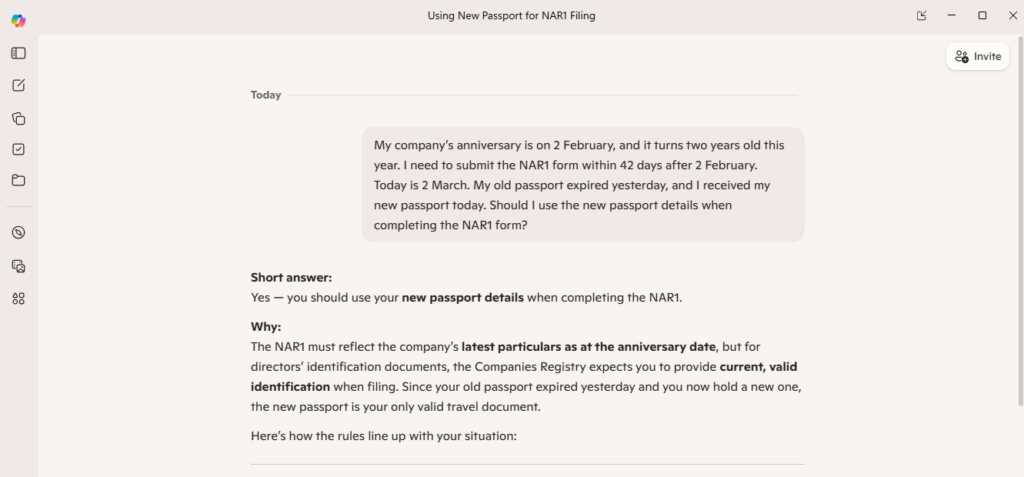
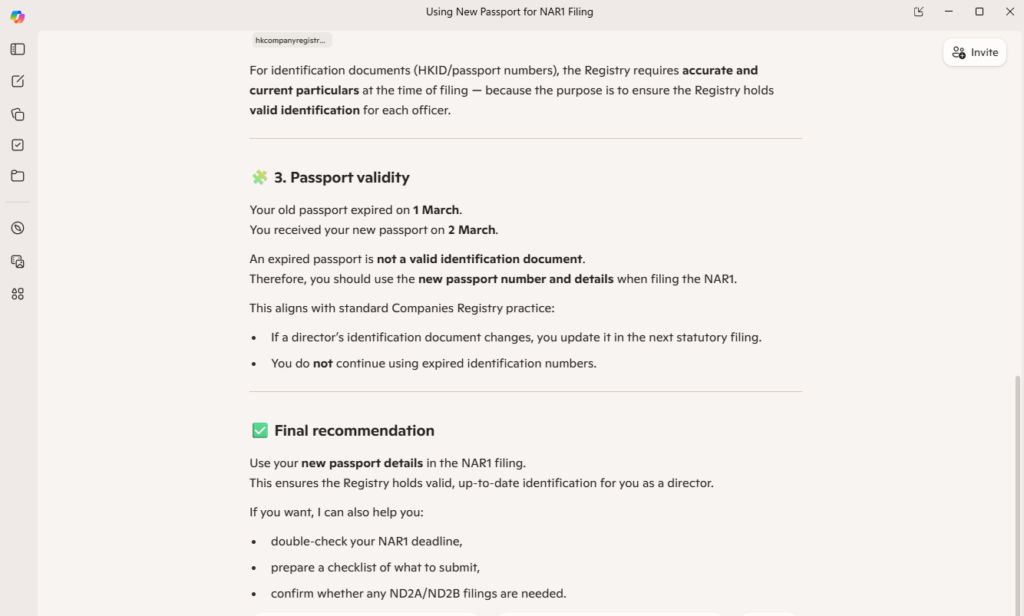
Copilot’s answer (incorrect)
Copilot firmly advised using the new passport details, stating that “the Companies Registry expects you to provide current, valid identification when filing” and that “an expired passport is not a valid identification document.” It concluded that the new passport number should be used in the NAR1.
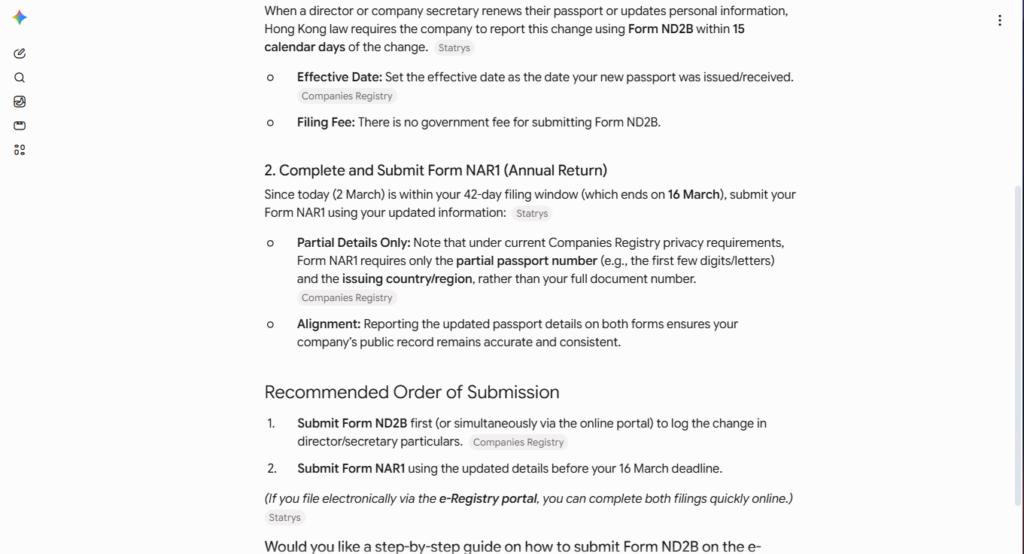
Gemini’s answer (incorrect)
It correctly noted the need to file Form ND2B but recommended the wrong sequence: submit ND2B first (or simultaneously), then file the NAR1 using the new passport details.
Correct position
Form NAR1 is a historical, point-in-time report of the company’s particulars as at the return date (2 February). Any change that occurs after that date does not belong in that year’s NAR1.
The Correct sequence is:
- File the NAR1 using the identification details that were valid on or before the return date (the old passport).
- Separately file Form ND2B to notify the Companies Registry of the new passport issued on 2 March.
Inserting the new passport number into the previous year’s NAR1 creates a chronological mismatch on the public record. Banks and investors reviewing the Companies Registry timeline will see a document that purports to report the position as at 2 February yet contains identification data that only existed later. This is not a minor technical error; it is a governance red flag that can trigger enhanced KYC reviews, account restrictions, or account closure if the bank’s internal deadline passes before any correction appears.
Gemini’s suggested order (ND2B first, then NAR1 with updated details) is the reverse of the correct sequence. The Companies Registry database presents filings chronologically. Mixing the order signals poor management and can damage how bankers and investors perceive the company’s corporate governance.
How Incorrect Annual Return (NAR1) Filings Can Damage Fundraising or Lead to Bank Account Closure
AI tools can quote statutory language accurately yet still fail to grasp the fundamental distinction between a point-in-time statutory return and a subsequent change notification. When a bank’s annual review uncovers a passport number whose issue date falls after the return date, the mismatch is immediately visible. Amendments take time to appear on the public register. If the bank’s deadline arrives first, the account may be closed. A closed account creates a negative record that subsequent banks will scrutinise.
The same risk applies to investment due diligence. Sophisticated investors and their lawyers examine the chronological order of filings. An inverted sequence indicates that the preparer does not understand basic corporate-governance chronology.
Scale of experience remains the differentiator. A firm that handles only a handful of NAR1 filings each month rarely encounters these edge cases and is more likely to accept AI output at face value. A firm that has served more than 46,000 clients has seen these situations repeatedly and understands both the legal silence in the Ordinance and the practical expectations of the Registry and the banks.
How a Professional Company Secretary Adds Value to Annual Return (NAR1) Filing
Some company secretarial firms simply execute whatever instructions the client provides. They will insert a new passport number into last year’s NAR1 if asked, without considering the consequences. This approach is functionally identical to uncritical reliance on AI. Criminal actors sometimes prefer such firms precisely because rigorous authenticity checks are absent.
Banks do not treat all company secretaries equally. When a bank indicates it has a good working relationship with a particular firm, it usually means the firm’s KYC and AML processes are reliable and that client files arriving from that firm tend to be complete, consistent, and free of high-risk red flags.
Get Started screens passports using the same AML systems employed by banks and verifies authenticity. We insert only information that is accurate as at the return date and require updated passport and address proof as part of the annual process. The result is filings that align with banking preferences and reduce the risk of unexpected account issues.
Think of it as choosing a surgeon: an experienced practitioner who has handled tens of thousands of cases inspires more confidence than a novice. Banks apply a similar lens. Files prepared by reputable firms with demonstrable track records and robust AML/KYC discipline generally move through compliance more smoothly. The opposite is also true: repeated exposure to incomplete or inconsistent filings from a provider leads banks to apply extra scrutiny to every subsequent case.
At Get Started we work with clients on an annual basis. We ask clarifying questions and request updated documents. While this may feel meticulous, it is precisely how we protect clients. Our experience allows us to streamline preparation while ensuring the NAR1 is correct, current as at the return date, and aligned with banking expectations, so that bank accounts are not closed by surprise.
Hong Kong Annual Return (NAR1) Official Rules, Deadlines and Late Filing Fees
Under the Companies Ordinance, every private company must deliver an Annual Return (Form NAR1) to the Companies Registry within 42 days after the anniversary of its incorporation. Sundays and public holidays are counted in the 42-day period. If the 42nd day falls on a Sunday or public holiday, the deadline is extended to the next working day that is neither a Sunday nor a public holiday.
The return must accurately reflect the company’s particulars as at that anniversary date. Only companies that have properly become dormant are exempt.
| Registration of annual returns Local private companies having a share capital (Form NAR1) | |
| If delivered | HK$ |
| within 42 days after the company’s return date@ | 105 |
| more than 42 days after but within 3 months after the company’s return date@ | 870 |
| more than 3 months after but within 6 months after the company’s return date@ | 1,740 |
| more than 6 months after but within 9 months after the company’s return date@ | 2,610 |
| more than 9 months after the company’s return date@ | 3,480 |
| @ the anniversary of the company’s date of incorporation |
From our experience with more than 46,000 clients, we observe that some founders assume the Companies Registry will waive or reduce late fees for foreigners unfamiliar with the rules. The Registry has no discretion under the Ordinance to waive or reduce these fees. Nationality or language is irrelevant.
The consequences extend beyond the monetary penalty. The Registry can prosecute the company or its directors for failure to file. Non-appearance at the Magistrates’ Court can result in contempt findings, while the outstanding NAR1 continues to appear on the public record. Banks that cannot obtain the required document will typically close the account.
Who Is Exempt from Filing the Hong Kong Annual Return (NAR1) under Section 663
Only companies that have applied for and obtained dormant status before the anniversary date are exempt. In many jurisdictions “annual return” refers to a tax filing; in Hong Kong it is a purely corporate statutory filing that updates the Companies Registry on structure and governance details, unrelated to tax.
Absence of operations does not equal dormancy. Dormancy is a formal legal status that requires a proper resolution and approval by the Companies Registry. In practice, most founders (based on our 46,000-client experience) choose not to pursue dormancy because the administrative effort outweighs the HK$105 saving. They simply file the NAR1 and pay the standard fee.
Practical Hong Kong Annual Return (NAR1) Filing Checklist
- Confirm the exact return date (incorporation anniversary).
- Prepare Form NAR1 to reflect particulars as at that date only.
- File any post-return-date changes (passport, address, etc.) on the correct change form (usually ND2B) after the NAR1.
- Use wet-ink original signatures for paper filings.
- Pay the correct fee; incorrect or insufficient payment causes the document to be returned while the late-fee clock continues to run.
- Retain a complete copy of everything submitted.
Accurate, chronologically consistent NAR1 filings protect both regulatory standing and banking relationships. Experience in handling edge cases and rigorous AML screening make a material difference.
Frequently Asked Questions
1. What is the deadline for filing the Hong Kong Annual Return (Form NAR1)?
Every private company must deliver Form NAR1 to the Companies Registry within 42 days after the anniversary of its incorporation. Sundays and public holidays are counted in the 42-day period. If the 42nd day falls on a Sunday or public holiday, the deadline is automatically extended to the next working day.
No. Form NAR1 is a point-in-time historical report of the company’s particulars as at the return date only. Any passport change that occurs after the anniversary date must be filed separately on Form ND2B after the NAR1 has been submitted. Including post-return-date information creates a chronological mismatch that banks treat as a governance red flag.
3. What are the late filing fees for the Hong Kong Annual Return (NAR1)?
Within 42 days: HK$105
More than 42 days but ≤ 3 months: HK$870
More than 3 months but ≤ 6 months: HK$1,740
More than 6 months but ≤ 9 months: HK$2,610
More than 9 months: HK$3,480
The Companies Registry has no discretion to waive or reduce these fees.
4. Are dormant companies required to file an Annual Return (NAR1) in Hong Kong?
Only companies that have formally applied for and obtained dormant status before the anniversary date are exempt under section 663 of the Companies Ordinance. Mere inactivity or lack of business operations does not qualify as dormancy.
5. Why do Hong Kong banks care so much about the Annual Return (NAR1)?
Banks use the NAR1 as a core annual due-diligence document to check for changes in shareholding, directorship, decision-making power, and identification details. Chronological errors or incorrect information can trigger enhanced KYC reviews, elevated risk ratings, or even bank account closure.
6. Is the Hong Kong Annual Return (Form NAR1) the same as a tax return?
No. In many countries “annual return” refers to a tax filing. In Hong Kong, Form NAR1 is a purely corporate statutory filing that updates the Companies Registry on the company’s structure and governance details. It has nothing to do with tax.
7. Why is the NAR1 considered a “point‑in‑time” document?
Because the Companies Ordinance requires the NAR1 to reflect the company’s particulars as at the anniversary date, not before, not after. This is different from change notifications (ND2B), which report events occurring after the return date. Mixing these two categories is a common mistake made by inexperienced preparers and AI tools.
8. Can late NAR1 filing affect my bank account?
Yes. Banks require the NAR1 for annual compliance reviews. If the NAR1 is late or missing, the bank may classify the company as non-compliant and close the account. A closed account becomes part of the company’s risk history and will be scrutinised by future banks.
Start Your Hong Kong Company
- 0% Corporate Tax for Offshore Profit.
- 0% Value Added Tax (VAT).
- 0% Capital Gain Tax.

Company Secretarial Service
Our comprehensive support which allows your company to operate efficiently without physical presence in Hong Kong.

Registered Business Address
Our company formation packages include a registered address service prepared for you hassle-free.